GPT-5 vs Claude 4.6 vs Gemini 3: Which LLM is Best for Enterprise AI Apps?
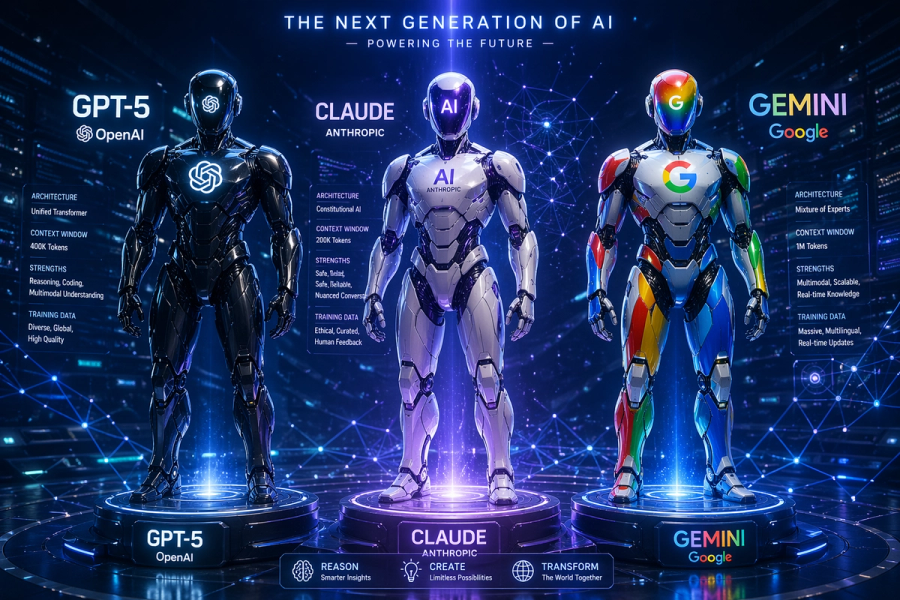
If you're building or scaling AI applications for your business in 2026, you're almost certainly asking the same question everyone in tech is asking: which large language model should we actually bet on? GPT-5, Claude 4.6, and Gemini 3 are the three dominant players right now, and each one brings a genuinely different set of strengths to the table. There is no single winner — but there is almost certainly a best choice for your specific use case. Let's break it all down.
A Quick Introduction to Each Model
GPT-5 is OpenAI's flagship model, released in August 2025. It's the most widely adopted LLM in the world, with deep integration across developer tools like GitHub Copilot and Cursor. Its biggest strength is its ecosystem — thousands of apps and services already run on it, making it the easiest model to plug into existing infrastructure.
Claude 4.6 (Sonnet) is Anthropic's current flagship for enterprise use. Anthropic was founded with a safety-first mission, and that philosophy runs through everything Claude does — from its careful, honest responses to its strong data privacy defaults. Claude Sonnet 4.6 is the model you're using right now when you chat on Claude.ai, and it sits in a sweet spot of high capability and cost-efficiency.
Gemini 3 Pro is Google's most advanced model, and it arrives with the sheer force of Google's infrastructure behind it. In late 2025, Google released Gemini 3 to business customers, positioning it as an "AI Supercomputer in a model" — combining a massive context window, multimodality, and advanced reasoning
How They Compare: Quick Overview
| Category | GPT-5 | Claude 4.6 | Gemini 3 Pro |
| Coding | Strong (multi-language) | Leader (SWE-bench 77.2%) | Good (large codebase analysis) |
| Reasoning | 92.8% GPQA | 91.3% GPQA | Leader (94.3% GPQA) |
| Writing | Versatile, adapts tone | Leader (natural prose) | Good, more generic |
| Context Window | Compaction (multi-window) | 1M tokens (beta) | 1M–2M tokens |
| Pricing (per 1M tokens) | $2.50 / $15 | $3 / $15 (Sonnet) | $2 / $12 |
| Best For | All-rounder, ecosystem | Coding, agents, compliance | Multimodal, research, cost |
Coding & Software Development
Claude 4.6 is the developer community's top pick for serious engineering work. It powers tools like Cursor and Claude Code, and leads real-world coding benchmarks.
- 77.2% on SWE-bench — highest of any model
- First to cross 60% on Terminal-Bench 2.0
- Best for autonomous coding agents and debugging
GPT-5 leads in multi-language support and has the strongest developer ecosystem.
- 88% on Aider Polyglot (C++, Go, Java, Python, Rust, and more)
- Deep integration with GitHub Copilot and VS Code
Gemini 3 Pro shines when code meets context — analyzing entire codebases or processing diagrams alongside code.
- Best for multi-file codebase analysis
- Handles diagrams, flowcharts, and technical docs in the same prompt
Writing & Content Generation
Claude 4.6 consistently produces the most natural, human-sounding prose. Ideal for reports, legal summaries, and long-form enterprise content.
- Outputs up to 128K tokens in a single pass
- Best instruction-following of any model tested
GPT-5 is the most versatile writer — adapts tone effortlessly across technical docs, marketing copy, and creative content.
Gemini 3 Pro is a capable writer but performs best when writing is paired with multimodal input or real-time research.
Reasoning & Research
Gemini 3 Pro leads pure benchmark reasoning with a 1,501 LMArena Elo — the first model to ever break 1,500.
Claude 4.6 produces the best multi-document research synthesis:
- More coherent cross-document connections
- More precise attribution and citation tracking
- Preferred by researchers for concise, readable deep-research reports
GPT-5 is fast and accurate on factual reasoning, though it can miss nuanced relationships in complex, multi-source tasks.
Safety, Privacy & Compliance

This is where Claude 4.6 stands apart from both competitors.
- API data is not used for training by default
- Built with safety-first principles from Anthropic's core research mission
- Trusted by organizations in healthcare, finance, and legal sectors
- Strong interpretability — you can understand why it responds the way it does
GPT-5 offers enterprise privacy protections but requires opting into specific tiers.
Gemini 3 Pro benefits from Google Cloud's compliance certifications, but your data lives within Google's infrastructure.
Context Window & Long-Document Handling
- Gemini 3 Pro — Up to 2M tokens natively. Best for processing entire codebases, books, or large document libraries.
- Claude 4.6 — 1M token beta via API. Best for cross-document synthesis and long autonomous tasks.
- GPT-5 — Uses "compaction" to work across multiple context windows, effective for extended multi-session tasks.
Pricing & Cost Efficiency

- Gemini 3 Pro — Most affordable. ~60% cheaper than Claude on output tokens. Best for high-volume or cost-sensitive deployments.
- GPT-5 — Mid-range pricing. Best balance of cost and ecosystem value.
- Claude Sonnet 4.6 — Competitive pricing, delivering near-Opus quality at a fraction of the cost. Smart default for most enterprise teams.
Ecosystem & Integrations
GPT-5 has the largest ecosystem by far. Best if your organization runs on Microsoft Azure, Office 365, or third-party AI tooling.
Claude 4.6 integrates with top developer platforms — Cursor, Windsurf, Slack, and major enterprise APIs.
Gemini 3 Pro integrates natively with Google Workspace, Google Cloud, and Search. Ideal for Google-first organizations.
How to Choose the Right Model
Choose GPT-5 if:
- Your team needs broad ecosystem support
- You work across many programming languages
- You want the most widely integrated platform
Choose Claude 4.6 if:
- Enterprise security and compliance are priorities
- You need long-running AI agents or complex coding workflows
- You want the best writing quality and instruction-following
Choose Gemini 3 Pro if:
- You need the largest context window
- You work with video, audio, or multimodal data
- You're a Google Workspace organization or are cost-sensitive at scale
Final Thoughts
In 2026, the best enterprise AI strategy is not picking one model and sticking with it forever. The smartest organizations are building workflows that route tasks to the right model — Claude for reasoning and writing, GPT-5 for code generation, Gemini for large document processing and multimodal tasks.
Start with the model that fits your primary use case. Test it on real internal workloads. And build your architecture to be model-agnostic so you can adapt as these models keep evolving.
The race between GPT-5, Claude 4.6, and Gemini 3 is making all three better, faster, and cheaper — and that's great news for every enterprise building on AI.
Written by