How Enterprises Are Building AI-Native Applications in 2026
There's a version of "AI strategy" that most enterprises ran between 2022 and 2024. Add a chat interface. Build a summarisation button. Ship a copilot. Call it done.
That era is over.
In 2026, the enterprises pulling ahead aren't adding AI to software. They're building software that is AI — systems that reason, coordinate, adapt, and execute autonomously. The architectural shift is as significant as the move to cloud computing. And unlike that transition, this one is moving faster than most teams anticipated.
This blog covers what AI-native actually means, why it matters right now, where it's delivering real results, and how leading enterprises are building it — without the fluff.
What "AI-Native" Actually Means
Let's settle this clearly because the term gets misused constantly.
AI-powered means you added AI features to existing software. Remove them and the product still works — just slower or with less convenience.
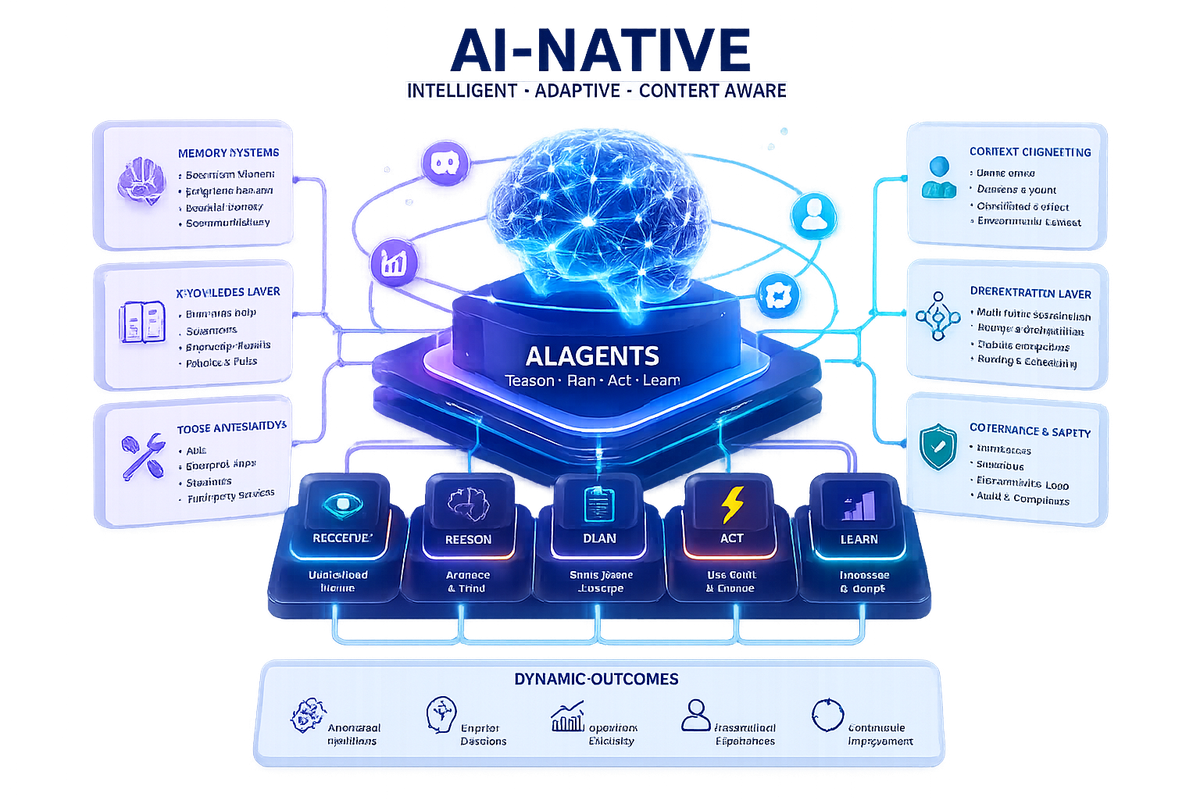
AI-native means AI is the structural core. Remove it and there is no product. The entire architecture — data pipelines, decision logic, user experience, cost model — was designed around AI from day one.
Traditional enterprise software runs on deterministic logic. Rules are predefined. Workflows are fixed. Automation requires manual configuration at every step.
AI-native applications work differently. Instead of hardcoded business logic, they use AI agents, memory systems, orchestration frameworks, and contextual reasoning to dynamically adapt to what users actually need and what conditions actually exist.
The result isn't smarter software. It's a fundamentally different kind of system — one that behaves less like an application and more like an operational intelligence layer embedded into your business.
Why Enterprises Are Rebuilding Now
Three forces are driving this shift simultaneously, and they're not going away.
Traditional SaaS is too rigid for modern operations. Conventional platforms were built around forms, dashboards, and fixed workflows. But enterprise operations today are dynamic, data-heavy, and constantly changing. Static software can't keep up. AI-native systems handle unstructured data, adapt workflows in real time, and automate complex decision-making that would have required teams of people a few years ago.
The pressure to do more with less is real. Every enterprise is under pressure to reduce operational overhead while improving output quality. AI-native applications make this possible — not through basic automation, but through agents that can independently manage customer support queues, run security monitoring, coordinate software deployments, and handle compliance checks without constant human supervision.
Enterprise data has become impossible to manage manually. Data now lives across APIs, cloud platforms, collaboration tools, documents, emails, databases, and dozens of SaaS systems simultaneously. Traditional software can't unify it. AI-native applications use RAG pipelines, semantic search, knowledge graphs, and contextual memory to reason across all of it — turning fragmented data into usable intelligence.
The Core Building Blocks
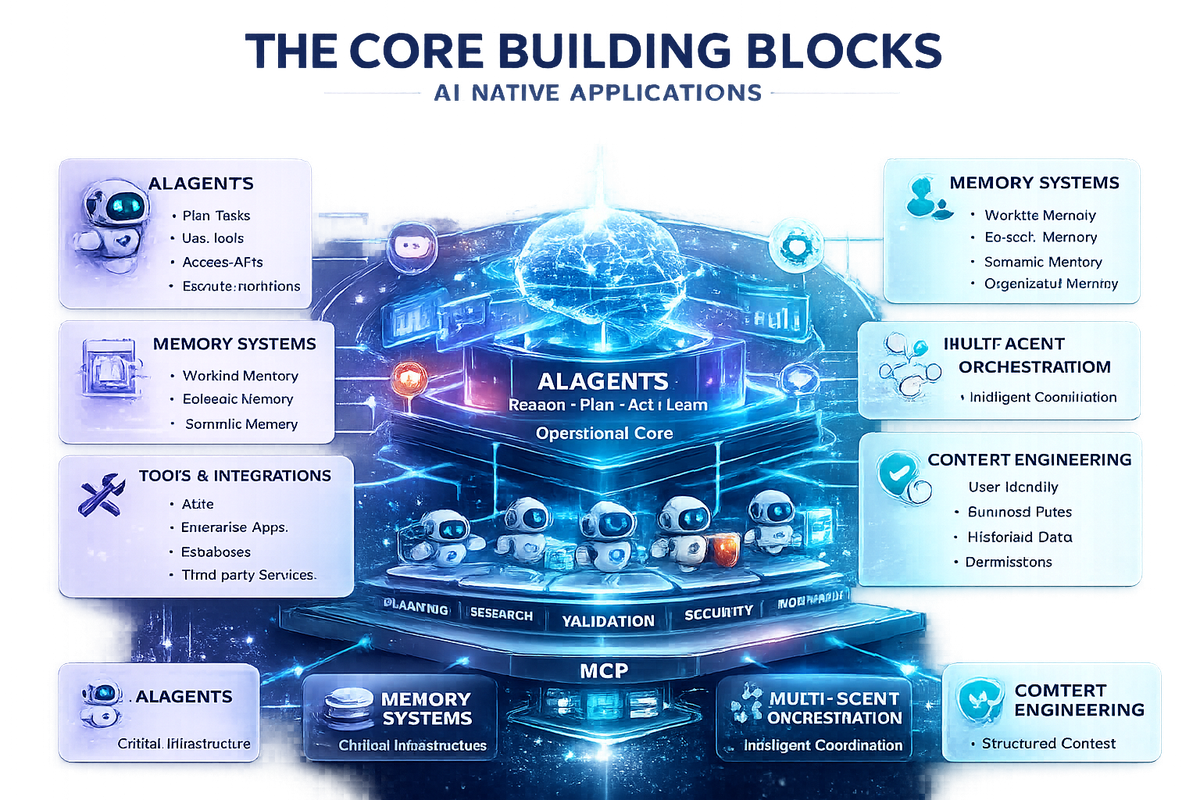
AI-native applications aren't just LLMs connected to APIs. They require entirely new infrastructure. Here's what that actually looks like.
AI Agents — The Operational Core
Modern AI agents are nothing like the chatbots that came before them. They plan tasks, use tools, access APIs, execute multi-step workflows, maintain state across sessions, coordinate with other agents, handle errors, and adapt based on outcomes.
This is the shift from "AI that answers questions" to "AI that gets things done." Agentic systems are replacing single-prompt interactions across enterprise software — and the gap in capability is enormous.
Memory — The Missing Layer Everyone Gets Wrong
Earlier AI systems were stateless. Every conversation started from zero. That made them useful for one-off queries and nearly useless for sustained operational work.
Modern AI-native applications use layered memory architectures:
- Working memory — what the agent is actively processing right now
- Episodic memory — what happened in recent sessions, so the agent builds continuity
- Semantic memory — the organisation's knowledge base, queryable by meaning not just keyword
- Shared organisational memory — context that agents across the enterprise can access
Memory infrastructure is now considered one of the most critical requirements for production AI systems. Without it, agents are perpetually starting over. With it, they compound their effectiveness over time.
Multi-Agent Orchestration — Teams, Not Solo Acts
Complex enterprise workflows are too large for a single agent. Leading organisations are deploying networks of specialised agents that collaborate:
A planner agent breaks down a complex objective. Research agents gather the required information. Validation agents check outputs against business rules. Security agents flag permission issues. Execution agents carry out the approved actions. Monitoring agents track results and escalate anomalies.
These systems coordinate through orchestration layers and open protocols — enabling workflows that no single agent, and no human team, could manage at the same speed and scale.
Context Engineering — The New Core Skill
Prompt engineering gets all the attention. Context engineering is what actually determines whether an AI-native application works in production.
Context engineering is the discipline of supplying AI systems with accurate, structured, permission-aware information: user identity, business rules, historical interactions, operational state, data access permissions, organisational knowledge, workflow dependencies. The quality of context directly determines the reliability of outputs. You can have the best model in the world and still get bad results if the context is wrong.
MCP: The Standard That Changes Everything
One of the most important developments in enterprise AI architecture over the past eighteen months is the rise of the Model Context Protocol.
MCP standardises how AI agents connect to the outside world — APIs, databases, enterprise tools, cloud systems, SaaS platforms, internal services. Instead of writing custom integration code for every tool, organisations adopt a protocol-based interoperability layer that any compliant agent can use.
The comparison to HTTP is apt. HTTP made it possible for any browser to communicate with any web server. MCP is doing the same thing for AI agents and enterprise systems — creating a universal interface that makes the entire ecosystem composable rather than custom-built.
By early 2026, MCP crossed 97 million monthly SDK downloads. Every major AI provider supports it. The registry has over 9,000 servers. Enterprises adopting it are seeing tool integration timelines drop from days to minutes. Those still building bespoke integrations are accumulating architectural debt that compounds with every new tool they need to connect.
Where It's Already Delivering Results
This is not future-state. These use cases are in production today.
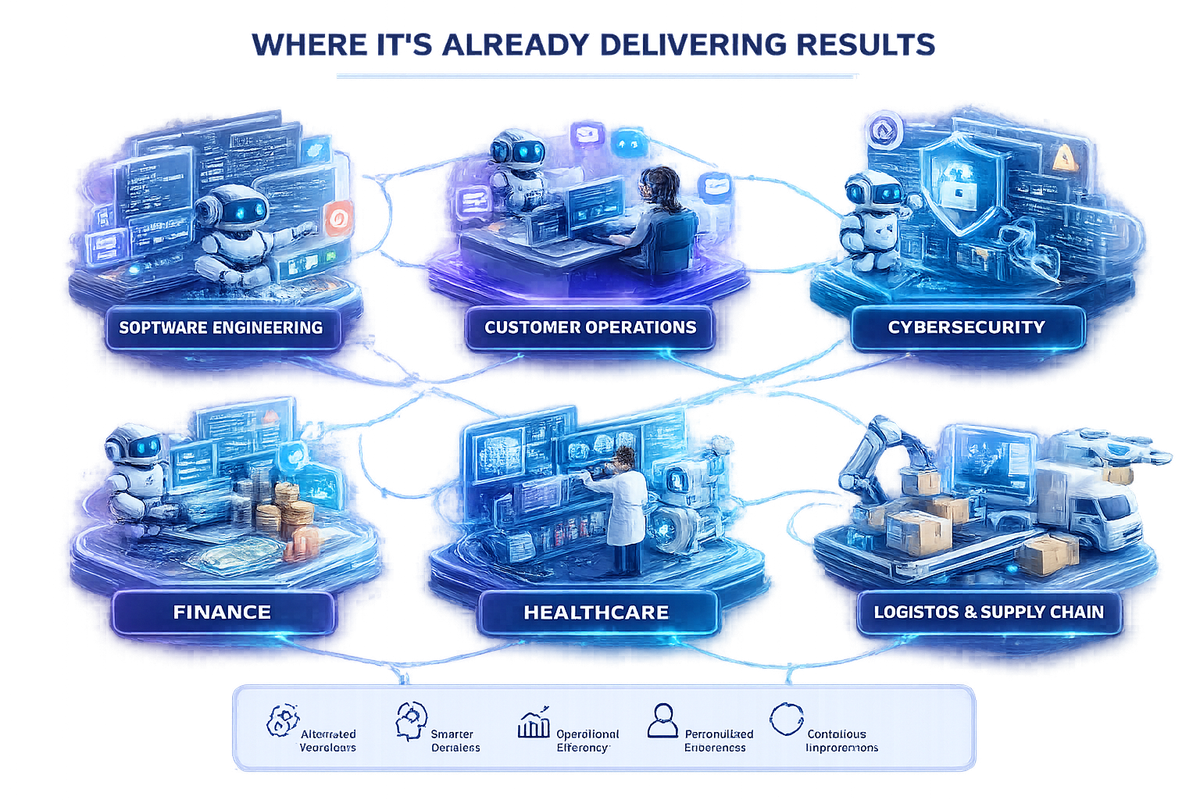
Software Engineering — AI agents draft code, run tests, summarise failures, propose fixes, and route to human reviewers only for final judgment calls. What previously required a full sprint of engineering work is being compressed into focused sessions. Teams are shipping more without adding headcount.
Customer Operations — AI-native support systems understand context, remember conversation history, resolve complex issues without scripts, and escalate intelligently with full context transferred. Customers stop repeating themselves. Resolution times drop significantly.
Cybersecurity — AI-native security systems detect new threat patterns and respond faster than human analysts can process alerts. They adapt to emerging attack vectors that rule-based systems can't anticipate. Security teams shift from reactive firefighting to strategic oversight.
Finance — Autonomous agents handle invoice reconciliation, payment routing, and fraud detection in real time. More significantly, AI systems surface risk patterns and strategic opportunities across financial data at a speed and scale that transforms how finance teams operate — from processing transactions to generating strategic insight.
Healthcare — AI-native applications combine medical imaging, patient records, lab results, and clinical notes to support faster and more accurate clinical decisions. Prior authorisation processing that took days takes minutes. Clinical documentation that consumed 40% of a physician's time is handled autonomously.
Logistics and Supply Chain — Predictive maintenance agents monitor sensor data continuously and flag equipment issues before they become failures. Inventory agents detect demand shifts and adjust purchase orders automatically. Disruptions that previously required manual coordination across teams are handled by agent workflows before a human is ever notified.
The Real Benefits — By the Numbers
Not projections. Reported results from production deployments:
- A global biopharma enterprise cut marketing agency spend by 20–30% while reducing content localisation from two months to a single day
- IBM reported $3.5 billion in cost savings with a 50% productivity increase across enterprise operations
- Amazon's AI-native recommendation engine generates 35% of total revenue
- One real estate platform compressed deal screening and underwriting from days of manual work to five to ten minutes
- Domain-specific AI models reduce error rates by 20–40% compared to generic models in regulated industries
- Tool integration timelines in MCP-native architectures dropped from three days to eleven minutes in documented migrations
The Honest Challenges
AI-native development is not easy. The enterprises struggling aren't struggling because AI doesn't work — they're struggling because they underestimated what production AI actually requires.
Reliability is an infrastructure problem, not a model problem. Most production failures in AI-native applications trace back to poor retrieval quality, stale data, or inadequate error handling — not to the underlying model's capability.
Governance cannot be retrofitted. Security, permission scoping, audit trails, and human-in-the-loop checkpoints need to be designed into the architecture from the start. Layering them on after the fact is expensive, incomplete, and often creates new vulnerabilities.
Cost management is a product decision. Inference costs scale with usage. If you haven't modelled cost per interaction into your pricing and unit economics from day one, you will discover an uncomfortable problem at the moment your product starts to grow.
Evaluation infrastructure is not optional. Every AI-native application shipped without automated quality benchmarks is one model update away from a silent regression that erodes user trust before anyone notices.
How to Actually Build It: The Sequence That Works
Start with the data layer, not the model. Clean your data, build your extraction pipelines, design your chunking strategy around semantic boundaries, add metadata, and establish freshness monitoring. Every output quality problem traces back to data. Fix it first.
Build your model router early. Classify requests by complexity and route to the appropriate model tier. Simple tasks to fast, cheap models. Complex reasoning to capable models. This decision alone can reduce inference costs by 60–70% without touching output quality.
Start with one agent, not many. Give it well-defined tools via MCP. Set clear success metrics. Measure where it breaks. Add specialised agents only when you have production evidence of where single-agent performance hits its ceiling.
Build evaluation before you ship. Set baselines. Run automated regression tests on every model update and data change. Capture human feedback on every correction. This compounds — every subsequent feature ships with less risk because you can actually measure whether it's working.
Design governance in, not on. Per-tool permission scoping. Audit trails on every model call. Input sanitisation for prompt injection. Escalation paths for high-stakes decisions. These are architecture components, not compliance checkboxes.
What Separates the Leaders from Everyone Else
The enterprises building AI-native applications successfully in 2026 are not winning because they have access to better models or bigger budgets. The models are available to everyone through the same APIs.
They're winning because they asked the right questions at the start — about data ownership, context quality, evaluation infrastructure, cost modelling, and governance — before those decisions became expensive to change.
The foundation is the competitive advantage. Not the model on top of it.
Companies still treating AI as a feature bolted onto existing software are accumulating architectural debt that gets harder to unwind every quarter. The gap is not closing on its own.
The era of AI-native enterprise software has already begun. The question is whether your organisation is building the foundation — or planning to catch up later.
Written by