CopilotKit Is Transforming the AI Agent Stack in 2026
Introduction
For the past two years, the AI industry has been obsessed with building smarter agents — better reasoning, faster tool calling, longer context windows. The model layer has improved dramatically. The infrastructure for running agents has matured. But one critical question kept getting quietly ignored:
How do agents actually work with the humans sitting at the other end of the screen?
Not in a chat window. Not in a playground demo. Inside real software — dashboards, CRMs, analytics tools, enterprise applications — where users need to see what an agent is doing, interrupt it, guide it, and trust it.
That is the problem CopilotKit is solving. And in 2026, with a $27M Series A, an open protocol adopted by Google, Microsoft, Amazon, and Oracle, and more than half the Fortune 500 using its tools in production, it is increasingly clear that CopilotKit has found the missing layer in the agentic stack.
This blog breaks down exactly what CopilotKit is, why the AG-UI protocol matters, what the Enterprise Intelligence Platform delivers, and why every developer building production agentic applications should be paying attention.
What Is CopilotKit?
CopilotKit is a best-in-class SDK for building full-stack agentic applications, Generative UI, and chat applications. It is the company behind the AG-UI Protocol — adopted by Google, LangChain, AWS, Microsoft, Mastra, PydanticAI, and more.
CopilotKit lets developers build agent-native applications with Generative UI, shared state, and human-in-the-loop workflows, connect to any agentic backend including any LLM or agent framework, and improve with the Enterprise Intelligence Platform for self-learning agents. It runs self-hosted or fully managed in CopilotKit Cloud.
Founded in 2023 by brothers Atai Barkai and Uli Barkai, the company started inside the Techstars Seattle accelerator. In two years it has grown from an open-source project into production infrastructure for the world's largest enterprises.
The company's founding belief is simple but ambitious: all UI is becoming AI, meaning all interactions between humans and technology are quickly becoming mediated by agentic systems.
The Missing Layer in the Agentic Stack
To understand why CopilotKit matters, you first need to understand the gap it fills.
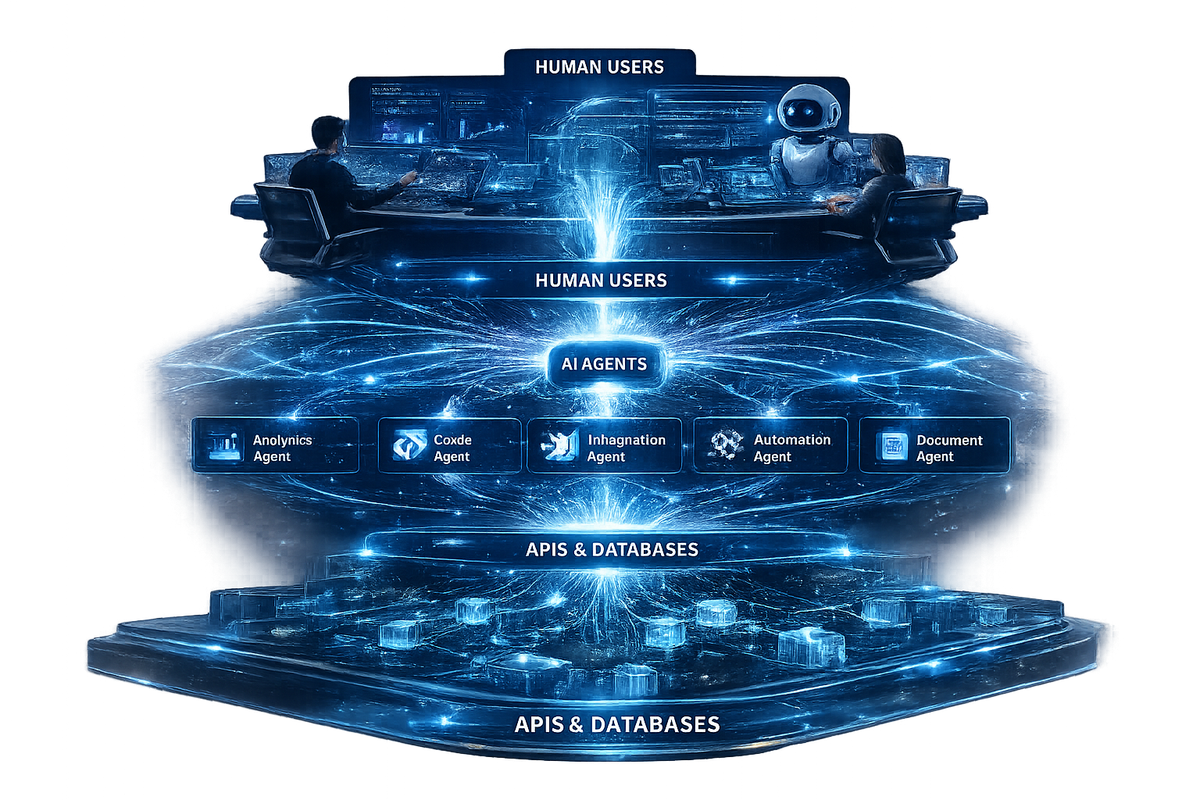
By 2025, the AI infrastructure community had solved two of the three fundamental communication problems in agentic systems:
How do agents access tools and data? Anthropic's MCP (Model Context Protocol) answered this — a standard way for agents to call external APIs, query databases, and interact with external systems.
How do agents talk to other agents? Google's A2A (Agent-to-Agent) protocol answered this — a standard for agent discovery, delegation, and result exchange in multi-agent systems.
But the third problem remained largely unsolved: how do agents communicate with the humans using the application?
As CEO Atai Barkai put it: "Every major software category is being rebuilt around agents. The leaders are learning what it takes to turn an agent into a real product experience. The hard part is not generating text. It is building the interaction layer — the layer that makes these systems usable, stateful and deeply integrated into software. That's the category we are building."
That interaction layer is exactly what CopilotKit and the AG-UI protocol provide.
4. AG-UI Protocol — The Open Standard Connecting Agents to Users
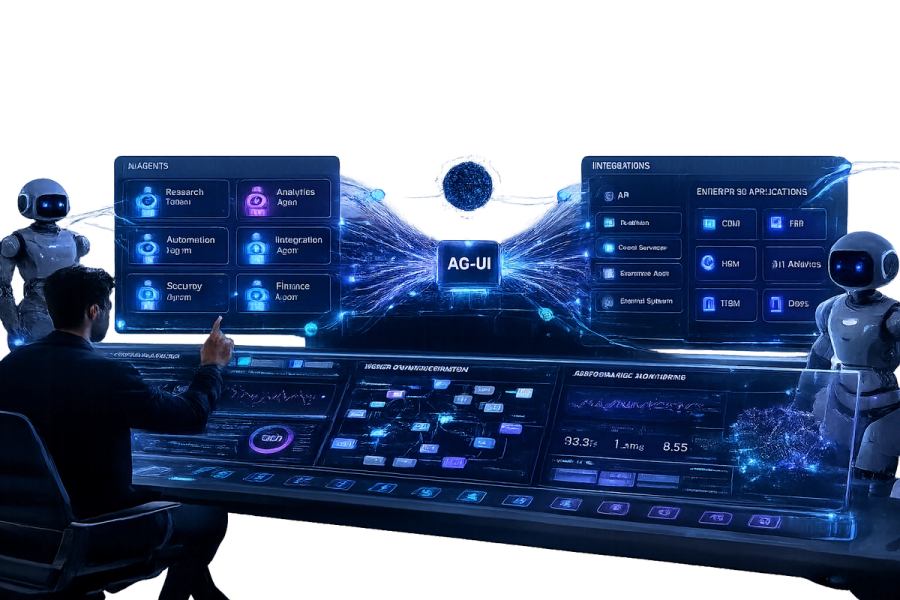
AG-UI (Agent-User Interaction) is the general-purpose, bidirectional connection between a user-facing application and any agentic backend. It is the connective layer that transforms agents from background processes into true collaborators — transparent, reliable, and always aligned with the user.
CopilotKit created AG-UI as an open standard for how AI agents communicate with software, letting agents generate interactive charts, update dashboards, and take actions inside apps. Companies including Google, Microsoft, Amazon, and Oracle have adopted the protocol.
The widely adopted, open source protocol standardizes how AI agents connect to and communicate with user interfaces like a web browser or an app, providing features such as streaming chat, front-end tool calls, and state sharing to enable human-in-the-loop functionality.
What AG-UI Enables
| Capability | What It Means in Practice |
| Streaming chat | Agent responses appear in real time as they are generated |
| Front-end tool calls | Agent can trigger UI actions directly — update a chart, fill a form |
| State sharing | Agent and frontend share synchronized state at all times |
| Human-in-the-loop | Users can interrupt, approve, redirect agent actions mid-execution |
| Generative UI | Agent renders dynamic React components at runtime |
| Bidirectional messaging | User and agent can exchange messages in both directions simultaneously |
Who Has Adopted AG-UI
AG-UI is backed by Google, Microsoft, Amazon, and Oracle, alongside frameworks like LangChain, Mastra, and PydanticAI — signaling genuine ecosystem convergence rather than a single-vendor play. AWS Bedrock AgentCore Runtime added AG-UI support in March 2026, further legitimizing the three-layer stack as the production architecture for agentic applications.
The Three-Protocol Stack: MCP, A2A, and AG-UI
The clearest way to understand CopilotKit's position in the market is to understand the three-protocol architecture that has emerged as the production standard for agentic applications in 2026.
Three protocols now handle three distinct communication problems: MCP (Model Context Protocol), created by Anthropic, standardizes how agents access external tools, databases, and APIs — it was donated to the Linux Foundation's Agentic AI Foundation and is now governed by a consortium that includes OpenAI, Google, Microsoft, AWS, and others. A2A (Agent-to-Agent), Google's protocol, handles how multiple agents discover each other, delegate tasks, and exchange results. IBM's competing Agent Communication Protocol merged into A2A in 2025.
A simple way to read the stack: MCP helps agents reach tools and data, A2A helps agents collaborate with other agents, and AG-UI helps agents collaborate with users.
Rather than picking a single protocol and hoping it wins, the 2026 playbook is to layer them: MCP for tool integration, A2A when agents need to coordinate with other agents, and AG-UI to connect the agent runtime to the user-facing application
The Three-Protocol Stack at a Glance
| Protocol | Created By | Solves | Layer |
| MCP | Anthropic | Agent ↔ Tools & Data | Infrastructure |
| A2A | Agent ↔ Agent | Orchestration | |
| AG-UI | CopilotKit | Agent ↔ User | Interface |
Together these three protocols form the complete communication surface of a production agentic system. CopilotKit owns the layer closest to the user — arguably the most commercially critical layer of the three.
CopilotKit Frontend SDKs — Building Agent-Native Applications
The open-source CopilotKit SDK is the foundation of everything the company offers. It is free, self-hostable, and designed to integrate with any existing application in minutes.
CopilotKit is the frontend stack for AI agents — production infrastructure for building Generative UI that lets users and agents collaborate directly inside the UI through interactive, stateful workflows. It supports A2UI and MCP apps, multimodal inputs including file uploads and voice with transcription, and is built for production with durable streaming including automatic mid-stream reconnections, mobile optimizations, and automatic migrations so updates work without friction. It integrates with all major agent frameworks and orchestration layers.
Core SDK Capabilities
| Feature | Description |
| Generative UI | Agent renders your own React components dynamically at runtime |
| Shared State | Synchronized state layer between agent backend and frontend UI |
| Human-in-the-loop | Approvals, edits, and guided decision steps built into the workflow |
| Durable Streaming | Automatic mid-stream reconnections — no broken agent sessions |
| Voice Support | Voice input and output with full transcription support |
| File Uploads | Multimodal input including documents and images |
| MCP Apps | Built-in support for Model Context Protocol tool connections |
| Mobile Optimized | Built for production mobile experiences out of the box |
Framework Support
CopilotKit connects to any LLM including GPT and Claude, any agent framework including LangChain and Google ADK, and any protocol including MCP, A2A, and AG-UI. The architecture is built on open standards for interoperability without lock-in.
| Category | Supported Options |
| LLMs | GPT, Claude, Gemini, and any OpenAI-compatible model |
| Agent Frameworks | LangChain, LangGraph, Google ADK, Mastra, PydanticAI, CrewAI |
| Protocols | AG-UI, MCP, A2A |
| Frontend Frameworks | React, Angular |
| Deployment | Self-hosted or CopilotKit Cloud |
Enterprise Intelligence Platform — Persistent Memory for Agents
The Enterprise Intelligence Platform is CopilotKit's commercial product — a managed layer that sits on top of the open-source SDK and adds the capabilities that production enterprise deployments require.

The startup generates revenue through CopilotKit Enterprise Intelligence, a self-hosted product that adds persistent conversation threads, analytics, and real-time learning capabilities.
What Makes the Persistence Layer Different
A Thread in CopilotKit captures the full interaction surface of an agentic application over time, not just the text exchange. Generative UI — dynamic UI components rendered by the agent at runtime — are captured and stored, not just the text prompts that triggered them. Human-in-the-loop workflows including approvals, edits, and guided decision steps taken by users during agent execution are preserved as part of the interaction trace. Shared state — the synchronized state layer between the agent backend and the frontend UI — is recorded so the agent and the application can resume from an identical shared context. Voice input and output persist across sessions, which is important for agentic applications that support speech interfaces.
This is architecturally significant. Most "memory" implementations in agentic systems store flat arrays of chat messages. CopilotKit's Thread persistence captures the full interaction surface — UI state, human decisions, voice, shared context — making it possible for agents to truly resume where they left off.
Enterprise Intelligence Platform Features
| Feature | What It Delivers |
| Persistent Threads | Full interaction history including UI state, voice, and human decisions |
| Analytics | Usage patterns, agent performance, interaction insights |
| Continuous Learning | Agents improve from real user interactions over time |
| Self-Improving Agents | System learns what works and adapts automatically |
| Self-Hostable | Deploy on your own infrastructure for data sovereignty |
| Cloud Managed | Fully managed option in CopilotKit Cloud |
Who Is Already Using CopilotKit?
The adoption numbers are the most compelling part of the CopilotKit story.
CopilotKit's core tools are open source with more than 40,000 GitHub stars and what the company says are millions of installs per week. More than half of Fortune 500 companies use its tools, primarily through the open-source project but also as paying customers of its enterprise product.
Enterprise customers including Deutsche Telekom, Docusign, and Cisco are already in production with the platform.
The Fortune 500 figure deserves special attention. For a two-year-old startup with 20 employees, having production deployments at the majority of the world's largest companies is not a typical growth trajectory. It reflects both the quality of the open-source tooling and the genuine gap it fills in enterprise AI stacks.
The $27M Series A — What It Signals
CopilotKit raised $27 million in Series A funding led by Glilot Capital, NFX, and SignalFire, and launched an enterprise product aimed at helping companies build user-facing agentic applications.
But the fundraise itself is less important than what it validates. For a company that already has half the Fortune 500 using its tools without significant institutional funding, the Series A is not a survival round — it is a scaling round. The signal it sends is that the agentic frontend layer is a real, fundable, enterprise-critical infrastructure category.
The agentic AI market is projected to reach $9 to 11 billion in 2026 and could exceed $139 billion by 2034, making protocol-level infrastructure plays like AG-UI critical bets.
The investors backing this round — Glilot Capital, NFX, and SignalFire — are infrastructure-focused funds. They are not betting on a feature. They are betting on a protocol becoming standard infrastructure, the way HTTP became standard for the web or REST became standard for APIs.
10. CopilotKit vs. The Alternatives
CopilotKit faces competition in the market for enterprise agent tools. Cloud platform Vercel's open-source AI SDK helps developers build AI applications with similar capabilities, and assistant-ui offers components for building AI chat interfaces. Meanwhile, OpenAI's Apps SDK is also an option for building richer interfaces, though only inside ChatGPT.
Here is an honest comparison of the major options
| Platform | Open Source | Protocol Standard | Framework Agnostic | Self-Hostable | Persistent Memory |
| CopilotKit | ✅ | AG-UI (open) | ✅ | ✅ | Enterprise |
| Vercel AI SDK | ✅ | Proprietary | Partial | ✅ | ❌ |
| assistant-ui | ✅ | None | Partial | ✅ | ❌ |
| OpenAI Apps SDK | ❌ | Proprietary | ❌ (ChatGPT only) | ❌ | Limited |
The key differentiator is protocol neutrality. CopilotKit's vendor-neutral, self-hostable design means teams can adopt any single layer without being locked into a proprietary runtime or forced to rebuild their existing stack.
For enterprises evaluating long-term infrastructure decisions, vendor lock-in is a genuine concern. CopilotKit's open-protocol approach is a structural advantage in enterprise sales conversations.
Getting Started — Code Examples
Getting started with CopilotKit takes minutes. Here is what the integration looks like in practice.
Installation
npm install @copilotkit/react-core @copilotkit/react-ui
Basic Setup — Wrap Your App
// app/layout.tsx
import { CopilotKit } from "@copilotkit/react-core";
import "@copilotkit/react-ui/styles.css";

export default function RootLayout({ children }) {
return (
<html>
<body>
<CopilotKit runtimeUrl="/api/copilotkit">
{children}
</CopilotKit>
</body>
</html>
);
}
Add a Copilot Chat UI
// components/MyCopilot.tsx
import { CopilotPopup } from "@copilotkit/react-ui";
export function MyCopilot() {
return (
<CopilotPopup
instructions="You are an assistant helping users manage their dashboard."
labels={{
title: "Dashboard Assistant",
initial: "How can I help you today?",
}}
/>
);
}
Define a CopilotAction — Agent Renders UI
// components/Dashboard.tsx
import { useCopilotAction } from "@copilotkit/react-core";

export function Dashboard() {
useCopilotAction({
name: "showSalesChart",
description: "Display a sales chart for the selected time period",
parameters: [
{ name: "period", type: "string",
description: "Time period: weekly, monthly, quarterly" },
{ name: "region", type: "string",
description: "Region to filter by" }
],
render: ({ args }) => (
<SalesChart period={args.period} region={args.region} />
),
});

return <div>Your dashboard content here</div>;
}
Human-in-the-Loop — Approval Before Action
useCopilotAction({
name: "deleteRecords",
description: "Delete selected customer records",
parameters: [
 { name: "recordIds", type: "string[]",
 description: "IDs of records to delete" }
 ],
renderAndWaitForResponse: ({ args, respond }) => (
<ConfirmationDialog
message={`Delete ${args.recordIds.length} records?`}
onConfirm={() => respond({ confirmed: true })}
onCancel={() => respond({ confirmed: false })}
/>
),
});
Connect to AG-UI Backend (Any Framework)
// For LangGraph, CrewAI, or any AG-UI compatible backend
import { CopilotKit } from "@copilotkit/react-core";

<CopilotKit
runtimeUrl="https://your-agent-backend.com/ag-ui"
agent="your-agent-name"
>
{children}
</CopilotKit>
Final Thoughts
CopilotKit's story in 2026 is the story of a company that correctly identified the missing layer in the agentic stack before almost anyone else — and built the infrastructure to fill it before the market caught up.
The AG-UI protocol is not a product feature. It is an open standard, adopted by every major cloud provider and AI framework, that defines how agents and humans collaborate inside real software. That is the kind of infrastructure bet that defines a generation of developer tooling.
For developers, the message is straightforward. The model layer is largely solved. The orchestration layer is maturing fast. The interface layer — how agents actually work with users inside real applications — is where the next wave of product quality will be won or lost.
CopilotKit is the most mature, most widely adopted, most framework-agnostic solution for that layer available today. With 40,000 GitHub stars, millions of weekly installs, Fortune 500 production deployments, and backing from every major cloud provider — it has earned the right to be the first tool you reach for when building agent-native applications.
At CognyX AI, we build production-grade agentic applications that work inside the tools your teams already use. Whether you need AG-UI integration, multi-agent orchestration, or a full agentic frontend stack built on CopilotKit — we design and deploy systems that deliver real value, not just impressive demos. Let's talk.
Written by