
Quality-AnalysisPublished on 4 min read
AI-Powered Testing: How QA Teams Can Automate Smarter, Not Harder

Anshul TiwariVP of Technology & Solutions
On this page
In the age of rapid development cycles and continuous delivery, Quality Assurance (QA) teams face an ever-increasing challenge: deliver faster without sacrificing quality. Traditional test automation, while a significant leap from manual testing, often succumbs to the sheer burden of maintenance and limited test coverage across complex, fast-changing applications.
The solution isn't simply doing more automation; it's about infusing intelligence into the testing process. This is the revolution of AI-Powered Testing, moving QA teams from brute-force automation to a smarter, more strategic approach that frees human experts to focus on complex, high-value tasks.
The Bottlenecks of Traditional Automation
Before diving into the solution, it's critical to understand the primary pain points that AI addresses:
- High Maintenance Overhead: Automated scripts often break with minor UI or code changes. Testers spend countless hours fixing tests instead of creating new ones. This is the essence of working harder.
- Brittle Locators: Traditional tools rely on static element locators (like IDs or XPaths). When a developer changes an element's attribute, the test fails, causing "flaky" results and wasted time.
- Test Case Blindness: Manual and basic automated test case creation can miss obscure edge cases or fail to prioritize tests based on real user risk.
- Slow Feedback Loops: Comprehensive regression suites can take hours or even days to run, slowing down the CI/CD pipeline and delaying feedback to developers.
AI-Powered Testing directly targets these inefficiencies, enabling QA to become a speed enabler instead of a delivery bottleneck.
The Core Pillars of Smart Automation
AI transforms the QA landscape by introducing capabilities that automate intelligence, not just repetition.
1. Self-Healing Test Scripts
This is arguably the most impactful feature for reducing the maintenance burden. Traditional tests fail instantly when a UI element's locator changes. AI-powered tools use Machine Learning (ML) and advanced algorithms to recognize elements based on a combination of properties—visual appea
ance, proximity to other elements, dynamic attributes, and historical data.
- How it Works: When a test run fails due to a changed locator, the AI analyzes the application's structure and history. It finds the new, corresponding element, automatically updates the test script's locator, and continues the execution.
- The Result: Test maintenance effort is drastically reduced. QA engineers spend less time "babysitting" broken tests and more time on strategic testing activities.
2. Intelligent Test Case Generation and Optimization
Generative AI (GenAI) and ML move testing from manual effort to intelligent creation.
- From Requirements to Tests: AI can analyze user stories, functional requirements, and historical defect data to automatically suggest or generate a comprehensive set of test cases. Tools using Natural Language Processing (NLP) allow testers to write test instructions in plain English, which the AI then converts into executable code.
- Risk-Based Prioritization: ML models analyze past failures, recent code commits, code complexity, and usage patterns (telemetry) to predict high-risk areas in the application. Instead of running the entire regression suite, the QA team can prioritize running only the tests most likely to fail, significantly accelerating the feedback loop.
- Test Data Management: AI can create realistic, high-quality synthetic test data at scale, which is crucial for covering various scenarios, especially in regulated industries where real customer data cannot be used.
3. Advanced Defect Prediction and Root Cause Analysis
AI shifts QA from a reactive process (finding bugs after they appear) to a proactive system (predicting and preventing failures).
- Predictive Analytics: By analyzing application logs, performance metrics, and historical bug trends, AI can flag code commits or builds with a high probability of introducing defects, allowing developers to investigate before the code even reaches the staging environment.
- Smarter Triage: When a test does fail, AI tools can perform Automated Root Cause Analysis, linking the failure back to the specific code change, commit, or developer responsible. This drastically cuts down the time spent by engineers trying to reproduce and diagnose the issue.
4. Enhanced Visual and UI Validation
Traditional UI testing often misses subtle visual or layout defects. AI-powered visual testing tools use Computer Vision to see the application the way a human user does.
- Visual Regression: The AI compares the current UI to a pre-established baseline, but intelligently ignores irrelevant differences (like ads or timestamps). It only flags changes that impact the user experience, eliminating false positives and ensuring consistent UI/UX across devices and browsers.
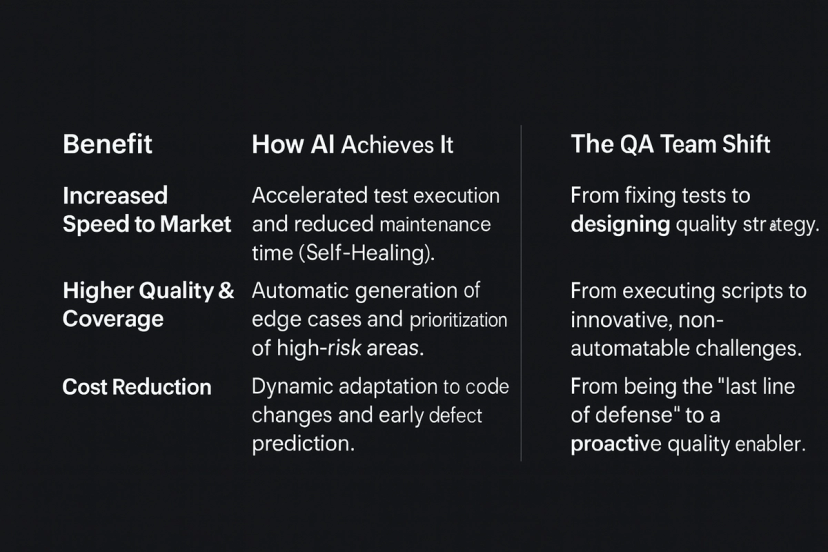
Benefits: The Smarter, Not Harder Payoff
Embracing AI-powered testing translates directly into tangible benefits for the entire development organization
The Roadmap to AI Adoption for QA Teams
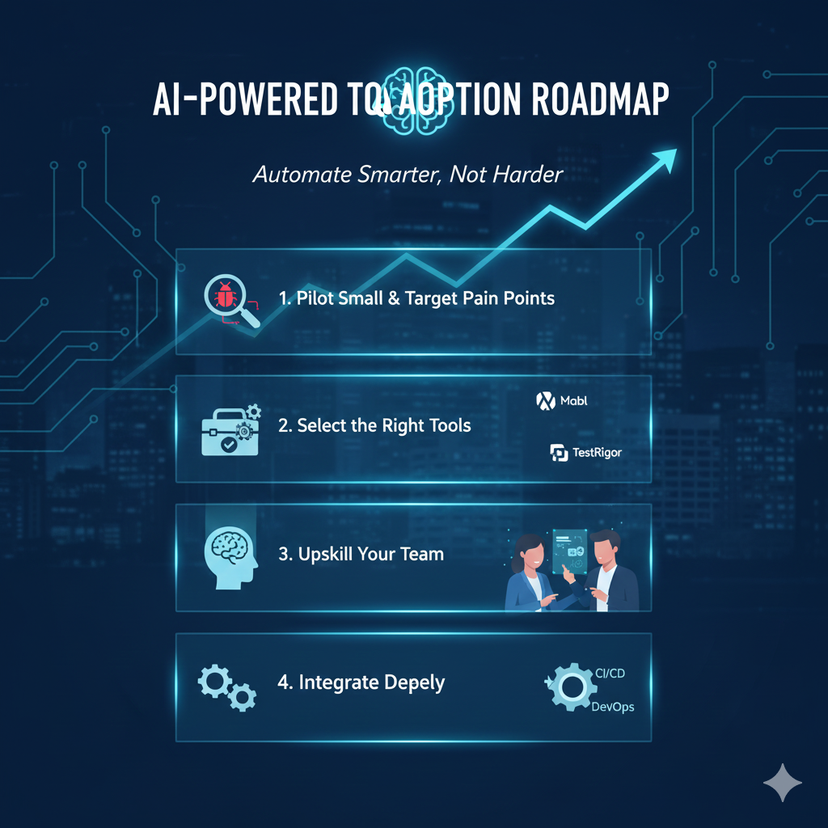
Implementing AI-powered testing requires a strategic shift, not just a tool purchase.
- Pilot Small and Target Pain Points: Don't try to automate everything at once. Start with a clear, recurring pain point—for example, a brittle regression suite or a process that generates massive amounts of flaky tests.
- Select the Right Tools: Evaluate AI-native platforms (like Mabl, TestRigor, Applitools, or Functionize) that offer core features like Self-Healing and NLP-based test authoring. Ensure the tool integrates seamlessly with your existing CI/CD pipelines (e.g., Jenkins, GitHub Actions).
- Upskill Your Team: AI isn't replacing testers; it's augmenting them. Invest in training your QA engineers to become "AI QA Testers." They will need expertise in data analysis, interpreting AI insights, and defining the optimal scope for the AI agent. Their focus shifts from coding tests to validating the AI's logic and focusing on usability and user experience (UX) testing.
- Integrate Deeply: Embed AI tools directly into the DevOps lifecycle. This ensures that test creation, execution, and analysis happen continuously and in real-time, providing immediate quality feedback with every code change.
AI is the future of QA, not as a replacement for human intellect, but as the powerful co-pilot that finally allows QA teams to automate smarter, not harder. By leveraging these intelligent capabilities, quality professionals can move beyond repetitive work and embrace their true role as strategic partners in delivering exceptional software.
Written by

Anshul Tiwari
VP of Technology & Solutions