Why QAOps is the Missing Piece in DevOps (2026 Guide)
Introduction: The DevOps Gap No One Talks About
Over the past decade, DevOps has transformed how software is built and delivered. Teams now deploy faster, release more frequently, and automate almost everything. On the surface, it looks like a perfect system. But underneath this speed lies a critical gap — quality.
Many organizations realized that while DevOps accelerated delivery, it didn’t guarantee stability. Faster releases often led to production bugs, broken user experiences, and increased rollback incidents. This is where QAOps emerges — not as a replacement for DevOps, but as the missing layer that ensures quality keeps pace with speed.
QAOps bridges the disconnect between development, testing, and operations by embedding quality into every stage of the pipeline. In 2026, it is no longer optional — it’s a necessity.
What is QAOps? A Practical Definition
QAOps stands for Quality Assurance Operations, and it extends DevOps by integrating testing deeply into the development and deployment lifecycle.
Instead of treating testing as a separate phase, QAOps ensures that:
- Testing starts early (shift-left)
- Continues during development
- Extends even after deployment (shift-right)
It is not just about automation tools — it’s about a mindset shift where quality becomes a shared responsibility across teams.
In simple terms:
- DevOps = Deliver faster
- QAOps = Deliver faster with confidence
The Problem with Traditional DevOps
DevOps solved many issues, but it also introduced new challenges when quality was not prioritized.
First, speed became the primary focus. Teams optimized pipelines to deploy quickly, sometimes at the cost of thorough testing. This led to unstable releases where bugs slipped into production.
Second, testing often remained siloed. QA teams were still working separately, running tests after development was complete. This created delays and late-stage defect discovery.
Third, feedback loops were incomplete. While DevOps enabled continuous integration and deployment, it didn’t always ensure continuous validation of product quality in real-world conditions.
The result was a paradox:
Faster releases, but lower reliability
QAOps directly addresses these gaps.
Why QAOps is the Missing Piece

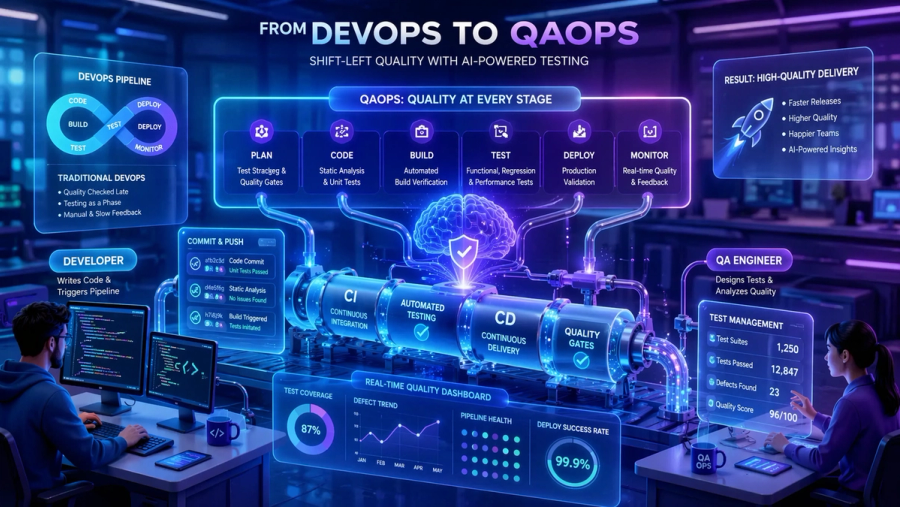
QAOps completes the DevOps lifecycle by embedding quality into every layer of the process.
It ensures that testing is not an afterthought but a continuous activity. Every code commit triggers automated tests, every deployment is validated, and every production issue feeds back into the system for improvement.
This creates a closed-loop system where:
- Code is continuously tested
- Issues are detected early
- Feedback is immediate
The biggest advantage is confidence. Teams can release faster without fear because quality checks are always running in the background.
Core Principles of QAOps
1. Continuous Testing
In QAOps, testing happens at every stage of the pipeline. From unit tests during development to integration and performance testing before deployment, everything is automated and continuous.
This reduces the risk of last-minute surprises and ensures that defects are caught early when they are cheaper to fix.
2. Shift-Left and Shift-Right Testing
QAOps expands testing across the entire lifecycle.
Shift-left means testing starts early — even before code is fully written. Developers and QA collaborate to define test cases alongside requirements.
Shift-right means testing continues after deployment. Real user behavior, monitoring data, and production insights are used to improve quality continuously.
This dual approach ensures end-to-end quality coverage.
3. Automation as the Foundation
Manual testing alone cannot keep up with modern release cycles. QAOps relies heavily on automation for:
- Regression testing
- API testing
- Performance validation
- Security checks
Automation ensures consistency, speed, and scalability — all essential for continuous delivery environments.
4. Collaboration Over Silos
QAOps eliminates the traditional separation between development, QA, and operations.
Instead of working in isolation:
- Developers write testable code
- QA engineers design automated test strategies
- Operations teams monitor real-world performance
This shared ownership of quality improves communication and reduces bottlenecks.
5. Real-Time Feedback and Observability
QAOps emphasizes real-time insights. Monitoring tools track application performance, user behavior, and system health after deployment.
This data is fed back into the development cycle, allowing teams to:
- Detect issues instantly
- Improve future releases
- Make data-driven decisions
Key Benefits of QAOps in 2026

Faster and More Reliable Releases
- QAOps allows teams to release quickly without compromising stability. Automated pipelines ensure every release is validated before reaching users.
Early Bug Detection
- By testing continuously, defects are identified at the earliest stage possible. This reduces debugging time and development costs.
Improved Customer Experience
- With fewer bugs and better performance, users experience more stable and reliable applications, leading to higher satisfaction and retention.
Reduced Production Failures
- Continuous monitoring and testing significantly reduce the chances of critical failures in live environments.
Scalable Quality Engineering
- QAOps enables teams to scale testing efforts alongside growing applications without increasing manual effort.
QAOps in the Age of AI and Automation
In 2026, QAOps is closely tied to AI-driven testing advancements.
AI enhances QAOps by:
- Generating intelligent test cases
- Predicting high-risk areas in code
- Automatically fixing broken test scripts
This makes QAOps even more powerful, as systems can now learn and improve over time rather than relying solely on predefined rules.
Challenges of Implementing QAOps
While QAOps offers significant benefits, adopting it is not without challenges.
Organizations often struggle with:
- Transitioning from manual to automated testing
- Upskilling QA teams in DevOps tools
- Integrating testing into existing pipelines
- Cultural resistance to shared responsibility
However, these challenges are temporary. The long-term gains far outweigh the initial effort.
How to Start Adopting QAOps
To implement QAOps effectively, organizations should begin with a structured approach.
- Start by integrating automated testing into CI/CD pipelines. Focus on high-impact test cases such as regression and API testing.
- Next, encourage collaboration between teams. Break down silos and ensure developers, QA engineers, and operations teams work together.
- Invest in tools that support automation, monitoring, and continuous testing. At the same time, train teams to adopt a quality-first mindset.
- Finally, measure success using quality metrics such as defect rates, test coverage, and release stability.

The Future of QAOps
QAOps is not just a trend — it represents the future of software quality engineering.
As systems become more complex and release cycles become shorter, the need for continuous quality assurance will only grow.
In the coming years, QAOps will evolve further with:
- Fully autonomous testing systems
- AI-driven quality predictions
- Deeper integration with cloud and microservices architectures
Organizations that adopt QAOps early will gain a competitive advantage by delivering faster, more reliable software.
Conclusion: From Speed to Confidence
DevOps revolutionized speed, but QAOps brings confidence.
- Without QAOps, DevOps is incomplete. It risks becoming a pipeline that delivers quickly but unreliably. With QAOps, organizations achieve the perfect balance — rapid delivery with high quality.
- In 2026, success is no longer defined by how fast you release, but by how well your software performs in the real world.
- QAOps is not just the missing piece — it is the foundation of modern software delivery.
Final Takeaway
If DevOps is the engine, QAOps is the safety system that ensures the journey is smooth, stable, and successful.
Organizations that understand this shift are not just building software faster — they are building it better.
Written by