
Artificial IntelligencePublished on 7 min read
Why Most AI POCs Fail—and How to Ship Real AI Features

Anshul TiwariVP of Technology & Solutions
On this page
Artificial Intelligence has moved from experimentation to expectation. Clients no longer ask “Can we build AI?” — they ask “Why isn’t our AI delivering business value?”
Despite massive investment, over 70% of AI Proofs of Concept (POCs) never make it to production. They look impressive in demos, win internal buy-in, and generate excitement — only to stall, get shelved, or quietly disappear.
What Is an AI POC — and Why Companies Build Them
An AI Proof of Concept is a small, experimental implementation designed to validate whether AI can solve a specific problem.
Typical AI POC goals:
- Validate feasibility of AI use cases
- Demonstrate value to stakeholders
- Explore model capabilities
- Test datasets and workflows
POCs are meant to answer “Is this possible?”
Production systems must answer “Is this reliable, scalable, and profitable?”
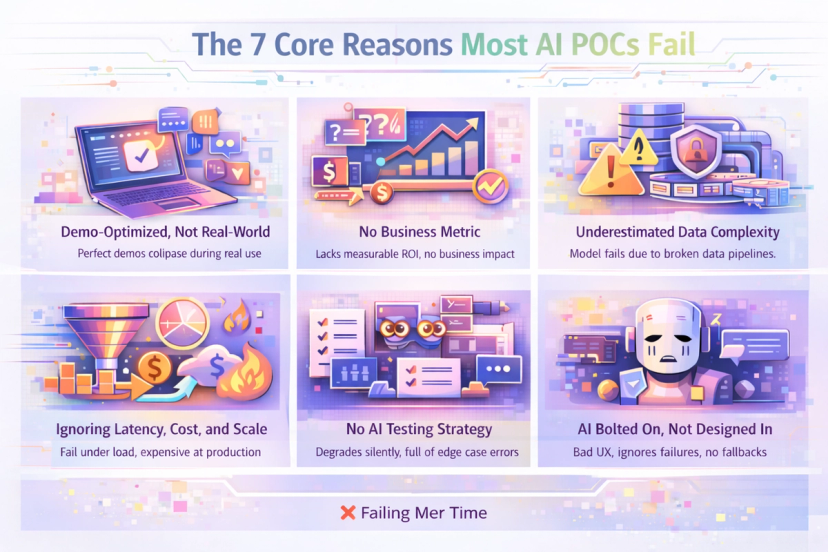
The 7 Core Reasons Most AI POCs Fail
A Deep, Practical Analysis with Real-World Context
AI Proof of Concepts (POCs) are often approved quickly, built rapidly, and demoed impressively—but very few survive the journey to production. Industry data consistently shows that over 70% of AI POCs never scale, not because the models fail, but because the surrounding system does.
Let’s break down the real, often unspoken reasons behind these failures.
1. The POC Is Not Anchored to a Business Outcome
The Core Problem
Most AI POCs begin with:
“Let’s see what AI can do here.”
Instead of:
“This process costs us ₹X per year—can AI reduce it by 20%?”
This creates a solution looking for a problem.
What This Looks Like in Practice
- Chatbots with no clear reduction in support tickets
- Forecasting models that don’t influence decisions
- GenAI tools that generate content nobody uses
Why It Fails
- No success criteria
- No ROI measurement
- No executive sponsorship after the demo
How Mature Teams Fix This
- Define one primary business KPI
- Agree on a “kill or scale” decision before starting
- Tie the POC to cost, time, risk, or revenue
Rule: If you can’t measure success, you can’t justify scaling.
2. Data Reality Hits Too Late
The Core Problem
AI teams often assume data is:
- Available
- Clean
- Structured
- Governed
In reality, it’s usually fragmented, messy, and politically owned.
Common Data Failures
- 40–60% missing values
- Inconsistent labels
- PDFs and scanned documents
- Data spread across tools and teams
Why It Fails
- Models train on biased or incomplete data
- Output quality is inconsistent
- Teams spend 80% of time on data wrangling
How Mature Teams Fix This
- Perform a data readiness audit first
- Start with a narrow, high-quality dataset
- Assign data ownership
- Build reusable pipelines
Truth: AI POCs fail more due to data than models.
3. Built as a Demo, Not as a System
The Core Problem
POCs are often built to:
- Impress stakeholders
- Work once
- Avoid engineering rigor
This creates “demo-ware”.
Typical Red Flags
- Jupyter notebooks in production
- Hardcoded prompts
- No error handling
- No observability or logs
Why It Fails
- Can’t scale users
- Costs explode
- Model behavior is unpredictable
How Mature Teams Fix This
- Use APIs and service-based architecture
- Log inputs, outputs, and failures
- Design for latency, cost, and retries
- Treat prompts as versioned assets
POC ≠ Prototype.
A POC must survive real-world usage.
4. Missing Domain Expertise in Model Design
The Core Problem
AI teams understand models—but not the business reality.
This causes:
- Incorrect assumptions
- Wrong success metrics
- Misaligned outputs
Real-World Examples
- AI flags “fraud” that compliance can’t act on
- Legal AI generates answers without citations
- Medical AI ignores workflow constraints
Why It Fails
- Users don’t trust the output
- Adoption drops
- Edge cases break confidence
How Mature Teams Fix This
- Embed domain experts in the AI team
- Validate outputs weekly
- Use human-in-the-loop systems
- Optimize for usefulness, not accuracy alone
AI without domain context is just noise.
5. Overhyped Expectations About AI Capabilities
The Core Problem
Stakeholders often believe AI will:
- Fully automate jobs
- Replace humans
- Be 100% accurate
- Work equally well everywhere
Reality doesn’t match hype.
What Happens Next
- Small errors get magnified
- Trust erodes quickly
- Projects lose executive support
Why It Fails
- Misaligned expectations
- No tolerance for probabilistic output
- Fear-driven pushback from teams
How Mature Teams Fix This
- Educate stakeholders early
- Set confidence thresholds
- Position AI as decision support
- Track improvement, not perfection
AI is probabilistic, not deterministic.
6. No Clear Path from POC to Production
The Core Problem
POCs are approved easily—but nobody plans for “day two”.
After the demo:
- Ownership is unclear
- Infra isn’t ready
- Budget disappears
Typical Symptoms
- “Let’s revisit next quarter”
- POC sits unused
- Team moves to the next experiment
Why It Fails
- No DevOps or MLOps
- No monitoring or retraining plan
- No accountability
How Mature Teams Fix This
- Define ownership before starting
- Plan CI/CD and monitoring
- Secure infra and budget upfront
- Assign SLAs
If no one owns it, it dies.
7. Security, Compliance, and Ethics Are Ignored Until It’s Too Late
The Core Problem
POCs often bypass:
- Data privacy
- Access control
- Compliance requirements
- Bias and hallucination checks
This creates enterprise blockers.
Real-World Risks
- Sensitive data leaks to LLMs
- Regulatory violations
- Brand trust damage
- Legal exposure
Why It Fails
- Security teams stop deployment
- Legal rejects approval
- Trust collapses internally
How Mature Teams Fix This
- Apply governance from day one
- Use private or secure model deployments
- Log and audit all AI interactions
- Red-team prompts and outputs
If it can’t pass security, it can’t ship.
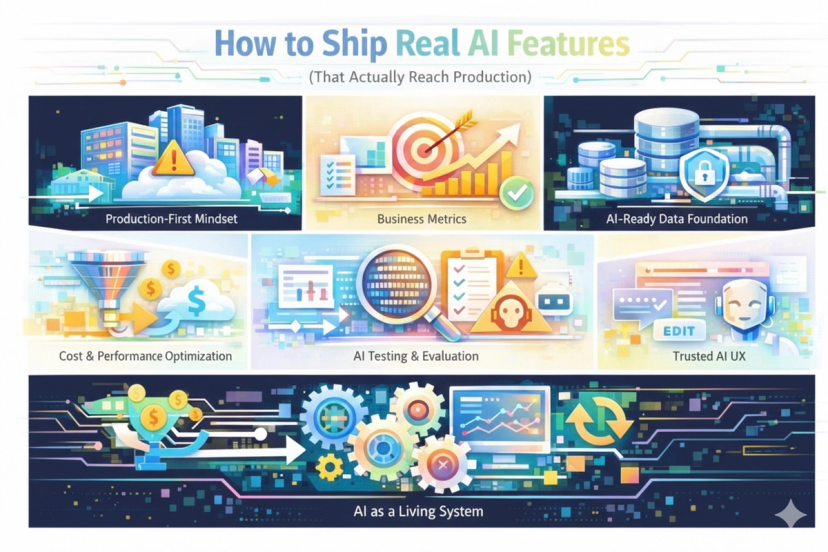
How to Ship Real AI Features (That Actually Reach Production)
Shipping AI to production is not about choosing the best model or writing clever prompts. It’s about engineering discipline, systems thinking, and long-term ownership. Let’s break down what that actually means in practice.
1. Start With a Production-First Mindset
Most AI projects fail because they are designed as experiments, not systems.
Before writing a single prompt or calling an API, teams must answer infrastructure-level questions:
Where will this run?
- Cloud (Azure, AWS, GCP)?
- On-prem?
- Edge devices?
- Hybrid environments?
Each choice impacts:
- Latency
- Security
- Cost
- Compliance
What happens when it fails?
AI will fail:
- Models time out
- APIs go down
- Outputs degrade
- Costs spike unexpectedly
Production systems must include:
- Fallback models or rule-based logic
- Graceful degradation (partial results instead of errors)
- User-visible error handling
How do we roll back?
- Can you switch models instantly?
- Can you revert prompts safely?
- Can you disable AI without breaking the app?
Key Principle:
Treat AI like infrastructure (databases, queues, APIs) — not a feature experiment.
2. Tie Every AI Feature to a Business Metric
AI is expensive. If it doesn’t move a metric, it won’t survive budgeting cycles.
Bad goals:
- “Add an AI chatbot”
- “Use GPT in the app”
- “Automate something with AI”
Good goals:
- Reduce support resolution time by 30%
- Increase test coverage by 25%
- Cut manual document processing by 40%
- Improve conversion rate by X%
Each AI feature should answer:
- What decision does this improve?
- What manual work does this replace?
- What cost does this reduce?
Production AI requires measurable ROI, not perceived intelligence.
3. Build an AI-Ready Data Foundation
AI doesn’t fail because models are bad — it fails because data systems are fragile.
Clean ingestion pipelines
- Structured + unstructured data
- Continuous updates
- Schema validation
- Deduplication
Versioned datasets
- Track what data trained or powered which version
- Enable rollback when outputs degrade
- Support audits and compliance
Access controls
- Who can read which data?
- Are prompts leaking sensitive info?
- Is PII protected?
Observability
- Input monitoring
- Output drift detection
- Data freshness checks
Rule: Invest in data engineering first, AI modeling second.
4. Design for Cost and Performance Early
Many AI systems die the moment real traffic hits.
Model routing
- Use cheaper models for simple tasks
- Escalate to smarter models only when needed
- Avoid “one-model-for-everything” designs
Caching
- Cache repeated queries
- Cache embeddings
- Cache intermediate results
Streaming outputs
- Improves perceived performance
- Reduces user drop-off
- Enables early termination when results are sufficient
Usage limits
- Rate limits
- Token budgets per user
- Hard caps for runaway prompts
Smart architecture beats bigger models every time.
5. Implement AI-Specific Testing & Evaluation
Traditional QA does not work for AI.
Golden datasets
- Curated examples with expected outputs
- Used for regression testing
- Updated as product evolves
Automated evaluations
- Accuracy scoring
- Relevance scoring
- Output consistency checks
- Safety filters
Hallucination detection
- Confidence thresholds
- Source verification
- Output grounding checks
Human-in-the-loop
- Manual review for edge cases
- Feedback loops to improve prompts
- Escalation paths for sensitive outputs
Testing is continuous — not a phase.
6. Design UX That Builds Trust
Accuracy alone does not guarantee adoption.
Good AI UX includes:
- Confidence indicators (certainty levels)
- Explanations of how outputs were generated
- Editable or correctable responses
- Manual override options
Why this matters:
- Users distrust black-box decisions
- Blind trust leads to mistakes
- Overconfidence causes operational risk
Trust drives usage. Usage drives ROI.
7. Treat AI as a Living System
Production AI is never “done”.
Ongoing responsibilities include:
- Monitoring output quality
- Retraining or refreshing data
- Updating prompts
- Switching or upgrading models
- Adjusting cost controls
Without maintenance:
- Accuracy degrades
- Costs rise
- User trust erodes
- Systems silently fail
AI systems evolve — or they decay.
Final Thought
Most AI failures are engineering failures, not AI failures.
Teams that succeed in 2026 will:
- Design AI like infrastructure
- Measure outcomes, not intelligence
- Invest in data and reliability
- Treat AI as a long-term system
That’s how AI moves from POC to production — and stays there.
Written by

Anshul Tiwari
VP of Technology & Solutions