
Artificial IntelligencePublished on 3 min read
The Future of AI Agents in Business: From Assistants to Autonomous Digital Workforces

Raish MominCTO
On this page
Introduction
Artificial Intelligence is entering a new era. While chatbots and automation tools have improved efficiency over the past decade, businesses are now moving toward something far more powerful: AI agents.
AI agents are not just conversational tools. They are intelligent, goal-driven systems capable of reasoning, planning, executing tasks, and continuously improving. As organizations face increasing operational complexity and competitive pressure, AI agents are emerging as the foundation of the next-generation enterprise.
The future of business will not just include AI—it will be powered by autonomous AI agents working alongside humans.
What Are AI Agents?
AI agents are autonomous systems that can:
- Understand objectives
- Analyze context
- Plan multi-step actions
- Execute tasks across systems
- Learn from outcomes
Unlike traditional automation, which follows predefined rules, AI agents operate dynamically. They adapt based on real-time data, feedback, and changing environments.
In simple terms:
Chatbots answer questions. AI agents achieve goals.
Why AI Agents Represent the Future of Business
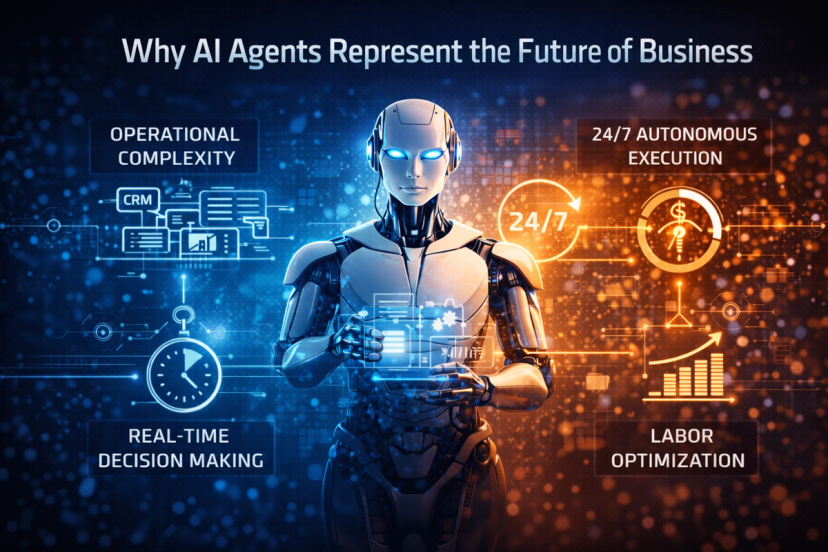
1. Rising Operational Complexity
Modern enterprises rely on dozens of platforms—CRMs, ERPs, marketing tools, analytics systems, and more. Managing these systems manually creates inefficiencies.
AI agents can:
- Orchestrate workflows across platforms
- Connect systems intelligently
- Automate multi-step processes end-to-end
2. Demand for Real-Time Decision-Making
Businesses cannot afford delays in decision-making. AI agents analyze data instantly and generate actionable insights, enabling:
- Faster approvals
- Smarter resource allocation
- Proactive risk management
3. Workforce Optimization
Labor costs are increasing globally. AI agents act as digital co-workers, capable of operating 24/7 without fatigue.
They do not replace humans—they amplify productivity by handling repetitive and analytical tasks, allowing teams to focus on strategy and creativity.
4. Shift Toward Autonomous Enterprises
The next phase of digital transformation is autonomy. AI agents move businesses from:
- Manual operations
- Reactive processes
- Static automation
To:
- Intelligent workflows
- Predictive operations
- Self-optimizing systems
AI Agents vs Traditional Automation
| Traditional Automation | AI Agents |
|---|---|
| Rule-based | Goal-driven |
| Static workflows | Adaptive |
| Limited scope | Multi-system execution |
| Human-triggered | Autonomous |
| Autonomous | Context-aware decision-making |
AI agents are not just an upgrade—they are a transformation.
Real-World Applications of AI Agents in Business
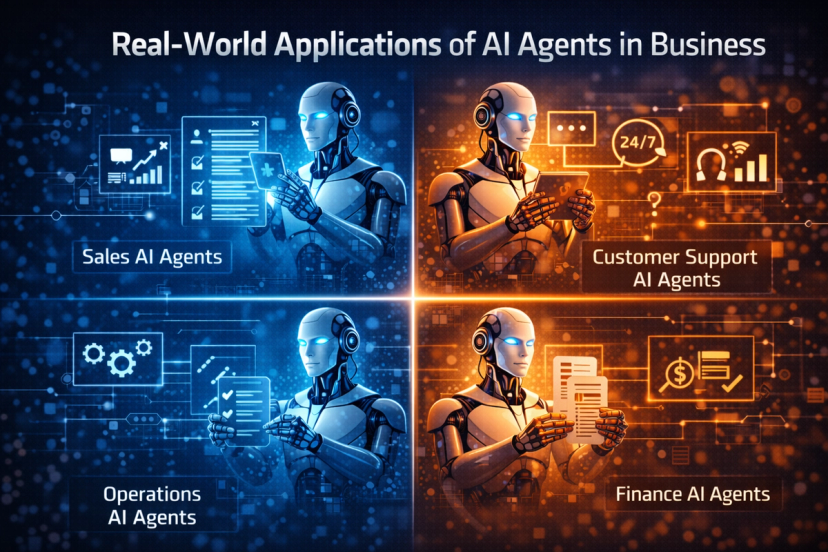
Sales AI Agents
- Qualify leads automatically
- Draft personalized outreach emails
- Update CRM records
- Predict conversion probability
Customer Support AI Agents
- Resolve complex queries
- Retrieve knowledge from enterprise databases
- Escalate intelligently when needed
- Provide multilingual 24/7 support
Operations AI Agents
- Monitor workflows
- Detect inefficiencies
- Trigger corrective actions
- Optimize supply chain decisions
Finance AI Agents
- Reconcile transactions
- Detect anomalies
- Generate reports
- Assist in compliance checks
HR & Internal AI Assistants
- Automate onboarding
- Answer employee queries
- Manage documentation
- Track engagement insights
AI Agents + RAG + Generative AI: The Enterprise Stack
The future of AI agents relies on combining three powerful technologies:
- Generative AI – For reasoning and content generation
- Retrieval-Augmented Generation (RAG) – For accurate, data-grounded responses
- Tool & API Integration – For real-world execution
Together, they create AI agents that are:
- Accurate
- Secure
- Context-aware
- Autonomous
This integrated stack enables true enterprise-grade AI systems.
Multi-Agent Systems: The Next Step
In the near future, businesses will deploy multiple AI agents working collaboratively, similar to departments within an organization.
Examples:
- A sales agent collaborates with a pricing agent
- A compliance agent verifies outputs from a finance agent
- An operations agent coordinates with a logistics agent
This orchestration will enable enterprises to operate with unprecedented efficiency.
Challenges to Address
While promising, AI agent adoption requires careful planning:
- Governance and compliance frameworks
- Data security and privacy safeguards
- Human-in-the-loop oversight
- Monitoring and performance evaluation
- Ethical AI deployment
Organizations must build AI agents responsibly and strategically.
The Road Ahead: AI Co-Workers by 2030
By 2030, we can expect:
- AI agents embedded into every enterprise software platform
- Digital employees working alongside human teams
- Autonomous departments powered by multi-agent systems
- Self-improving AI ecosystems
Businesses that adopt AI agents early will gain significant competitive advantages in agility, cost efficiency, and innovation.
How Cognyx AI Is Shaping the Future of AI Agents
At Cognyx AI, we design and deploy enterprise-ready AI agents that:
- Integrate securely with business systems
- Use RAG for accurate, private intelligence
- Automate complex workflows
- Scale across departments
- Deliver measurable ROI
Our focus is building AI systems that are not experimental—but production-ready and future-proof.
Conclusion
AI agents represent the next frontier in enterprise transformation. They move businesses beyond simple automation into intelligent, autonomous operations.
The future of business is not just digital—it is autonomous, adaptive, and AI-driven.
Organizations that embrace AI agents today will define the competitive landscape of tomorrow.
Written by

Raish Momin
CTO