AI Agents vs Chatbots: Understanding the Real Difference
Introduction: Why This Difference Matters
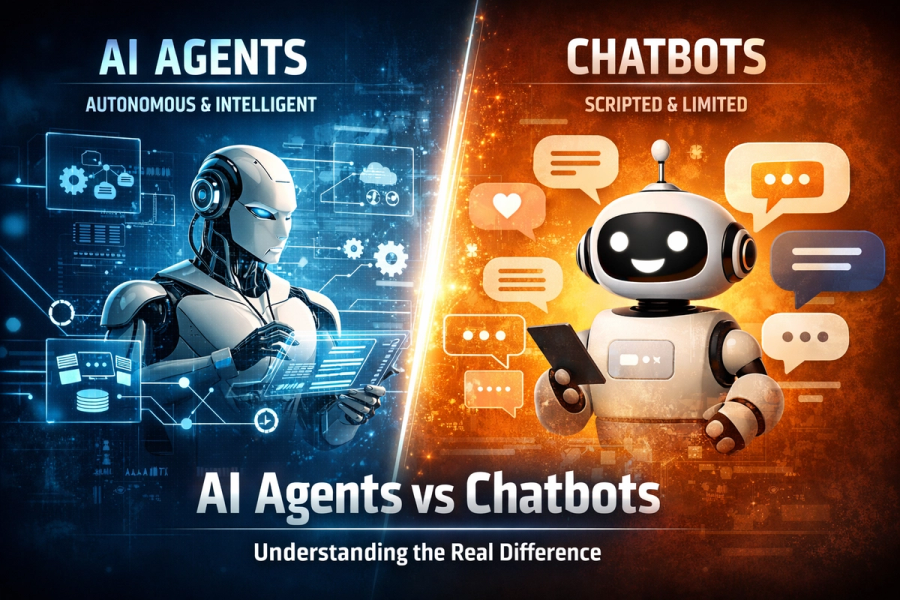
Many businesses believe AI agents and chatbots are the same thing. While both use artificial intelligence to interact with users, their capabilities, impact, and business value are fundamentally different.
Chatbots were designed to answer questions.
AI agents are designed to think, decide, and act.
Understanding this difference is critical for organizations planning intelligent automation, digital transformation, and scalable AI solutions.
What Are Chatbots?
Chatbots are conversational systems built to respond to user inputs. They are commonly used for:
- Customer support FAQs
- Website interactions
- Basic task guidance
Key Characteristics of Chatbots
- Reactive: Respond only when prompted
- Conversation-focused: Limited to chat interfaces
- Rule-based or intent-based
- Predefined workflows
- Minimal reasoning ability
Example:
A chatbot can answer:
“What are your business hours?”
But it usually cannot:
- Access multiple systems
- Perform complex actions
- Adapt to dynamic business situations
Chatbots are useful—but limited.
What Are AI Agents?
AI agents represent the next evolution of intelligent systems.
An AI agent is an autonomous system capable of:
- Understanding goals
- Reasoning about next steps
- Taking actions across tools and platforms
- Learning from outcomes
Key Characteristics of AI Agents
- Autonomous: Can operate independently
- Goal-oriented: Designed to complete tasks end-to-end
- Context-aware: Uses historical and real-time data
- Action-driven: Executes workflows, not just conversations
- Tool-integrated: Works with APIs, CRMs, databases, and SaaS tools
Example:
An AI agent can:
- Receive a support request
- Analyze urgency and sentiment
- Retrieve customer data from CRM
- Resolve the issue automatically
- Update records and notify teams
This is intelligent execution, not just conversation.
Core Differences: AI Agents vs Chatbots
| Feature | Chatbots | AI Agents |
| Primary Purpose | Answer questions | Achieve business goals |
| Autonomy | Low | High |
| Reasoning | Limited | Advanced |
| System Integration | Minimal | Deep, multi-system |
| Learning Ability | Static or limited | Continuous |
| Workflow Execution | No | Yes |
| Scalability | Limited | Enterprise-grade |
Business Impact Comparison
Chatbots: Tactical Benefits
- Reduce basic support workload
- Improve response time for FAQs
- Enhance user engagement
Best suited for:
Simple interactions and customer-facing Q&A.
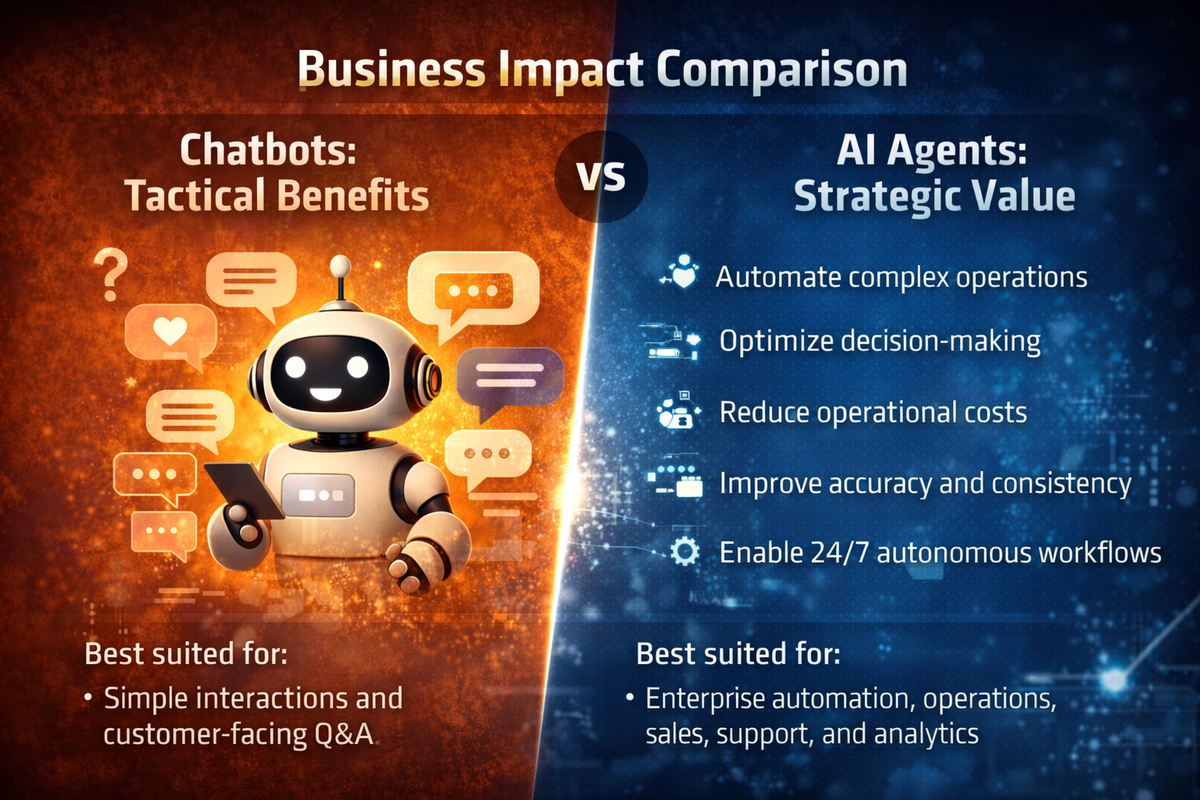
AI Agents: Strategic Value
- Automate complex operations
- Optimize decision-making
- Reduce operational costs
- Improve accuracy and consistency
- Enable 24/7 autonomous workflows
Best suited for:
Enterprise automation, operations, sales, support, and analytics.
Real-World Use Cases
Chatbot Use Cases
- Website FAQs
- Appointment booking
- Basic customer queries
- Lead capture forms
AI Agent Use Cases
- Intelligent customer support automation
- Sales lead qualification and follow-ups
- HR onboarding and employee assistance
- IT operations and incident management
- Financial reconciliation and reporting
- Supply chain and operations optimization
Architecture: Why AI Agents Are More Powerful
AI agents combine multiple components:
- Large Language Models (LLMs) for reasoning and understanding
- Knowledge bases for business context
- Tool and API integrations for real-world actions
- Orchestration engines for task planning
- Monitoring and feedback loops for continuous learning
Chatbots typically rely on single-layer conversation logic, limiting their scope.
Challenges When Moving Beyond Chatbots
Complexity
- AI agents are more complex to design and deploy.
Data & Integration
- Agents require clean data and system connectivity.
Governance
- Autonomous systems need control, auditing, and security.
Trust
- Businesses must ensure reliability and transparency.
- These challenges are solvable with the right architecture and expertise.
How CognyX AI Helps Businesses Build AI Agents
At CognyX AI, we help organizations evolve from chatbots to enterprise-grade AI agents by providing:
- AI agent strategy and consulting
- Custom AI agent development
- Generative AI and LLM integration
- Secure system and API integration
- Governance, monitoring, and optimization
Our solutions are designed to be:
- Scalable
- Secure
- Business-aligned
- Future-ready
When Should You Choose Chatbots vs AI Agents?
Choose Chatbots If:
- You need simple customer interaction
- Use cases are limited and predictable
- Minimal system integration is required
Choose AI Agents If:
- You want end-to-end automation
- Decisions require reasoning and context
- Multiple systems must work together
- Scalability and autonomy are critical
The Future: From Conversation to Intelligence
Chatbots were the starting point.
AI agents are the future.
As businesses face growing complexity and competition, the shift from conversational AI to autonomous intelligent systems will become inevitable.
Organizations that adopt AI agents today will lead tomorrow.
Conclusion
While chatbots and AI agents may appear similar on the surface, their capabilities and impact differ significantly. Chatbots handle conversations. AI agents handle outcomes.
Understanding this difference enables businesses to invest in the right AI solutions—ones that drive real, measurable value.
Written by