
Artificial IntelligencePublished on 9 min read
Perplexity Labs: The AI Workbench Redefining Productivity in the Digital Age

Bhim MridhaSr. AI Developer
On this page
In the fast-paced world of artificial intelligence, the transition from "knowing" to "doing" is the next great frontier. While standard AI chatbots have become our go-to for quick answers, a new breed of platform is emerging—one that doesn't just talk but builds.
Welcome to Perplexity Labs, the experimental po
werhouse of the Perplexity ecosystem. If Perplexity is the world’s most advanced "Answer Engine," then Labs is its specialized workshop, where data is forged into functional projects.
What Is Perplexity Labs? The Evolution of AI Assistance
- For years, AI assistance followed a linear path: you ask a question, and the AI provides a text-based response. Perplexity Labs marks a fundamental evolution in this relationship. It is an agentic creation engine designed to handle complex, multi-step projects that would traditionally take hours or days for a human to complete.
- While the standard Perplexity interface focuses on high-speed retrieval and citations, Labs is optimized for output density. It isn't just looking for an answer; it’s looking to build a deliverable—be it a comprehensive market report, a functional financial dashboard, or a specialized mini-web application.
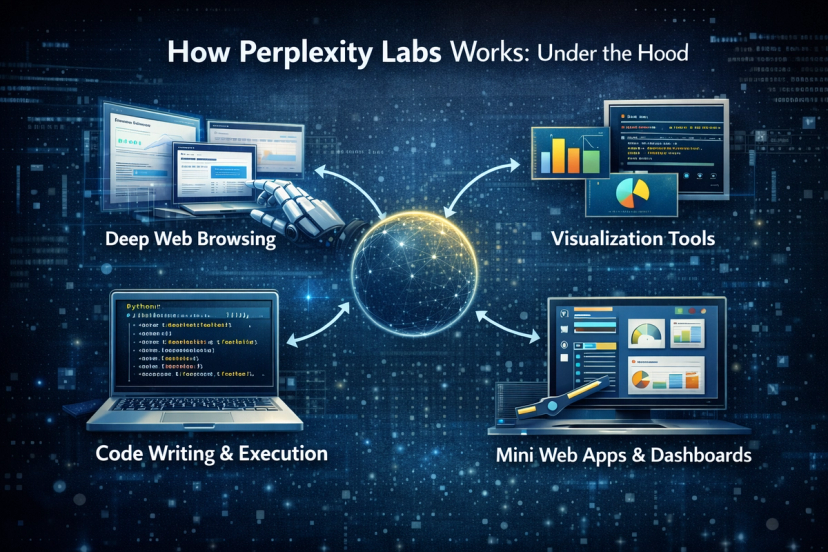
How Perplexity Labs Works: Under the Hood
At its foundation, Perplexity Labs operates less like a conversational AI and more like an autonomous project executor. Instead of responding with a single answer, it decomposes a goal into multiple stages — research, reasoning, execution, and output assembly — and runs them in a coordinated pipeline.
Think of Labs as a virtual analyst + developer + designer working in parallel, orchestrated by AI.
Deep Web Browsing (Context Assembly Layer)
Unlike standard AI search that retrieves a handful of top results, Perplexity Labs performs iterative, goal-driven web exploration.
Key differentiators:
- It refines queries dynamically as it learns more about the topic.
- Sources are cross-validated across multiple domains to reduce single-source bias.
- Context is stored and reused across steps instead of being discarded after one response.
This means Labs doesn’t just “look things up” — it builds a living research graph, similar to how a human researcher bookmarks, revisits, and re-evaluates sources while working on a project.
Result: outputs grounded in broader context, not isolated facts.
Code Writing & Execution (Action Engine)
Perplexity Labs doesn’t treat code as static text. It uses code as an execution mechanism.
What makes this unique:
- Code is written specifically to answer the task, not as a generic example.
- Execution results feed directly into the next step of reasoning.
- Data transformations, calculations, and simulations happen live, not hypothetically.
This allows Labs to:
- Clean messy datasets
- Generate spreadsheets with real formulas
- Perform multi-step analyses where outputs evolve dynamically
In practice, this is closer to how a data analyst uses Python or Excel than how a chatbot explains code.
Visualization Tools (Insight Translation Layer)
Visualization in Labs is not an afterthought — it’s a reasoning aid.
Instead of generating charts only at the end:
- Visuals are created to test hypotheses
- Graphs help validate trends before final conclusions
- Multiple visual formats may be tried before selecting the clearest one
This mirrors how professionals work: plot first, interpret second.
The result is not just prettier output, but clearer thinking translated into visuals.
Mini Web Apps & Dashboards (Interface Generation)
One of the most powerful — and underrated — aspects of Labs is its ability to generate interactive outputs, not just static files.
What’s happening under the hood:
- Data logic and UI logic are produced together
- Outputs are structured for interaction (filters, toggles, views)
- The AI anticipates how a user might explore the data, not just read it
This bridges a critical gap:
From analysis → usable product
Suddenly, an insight isn’t locked in a report — it’s accessible through an interface.
Assets Management (Output Orchestration)
Labs treats outputs as first-class artifacts, not chat messages.
Every generated item:
- Has a clear role in the project
- Is stored persistently
- Can be reviewed, reused, or exported independently
This makes Labs fundamentally different from conversational AI:
- Chat AI = ephemeral answers
- Labs = structured deliverables
It behaves more like a lightweight project workspace than a message thread.
Real-World Applications: From Concept to Output
Perplexity Labs transforms raw inquiry into functional business assets. It moves beyond "answering" to "producing" across several high-stakes domains:
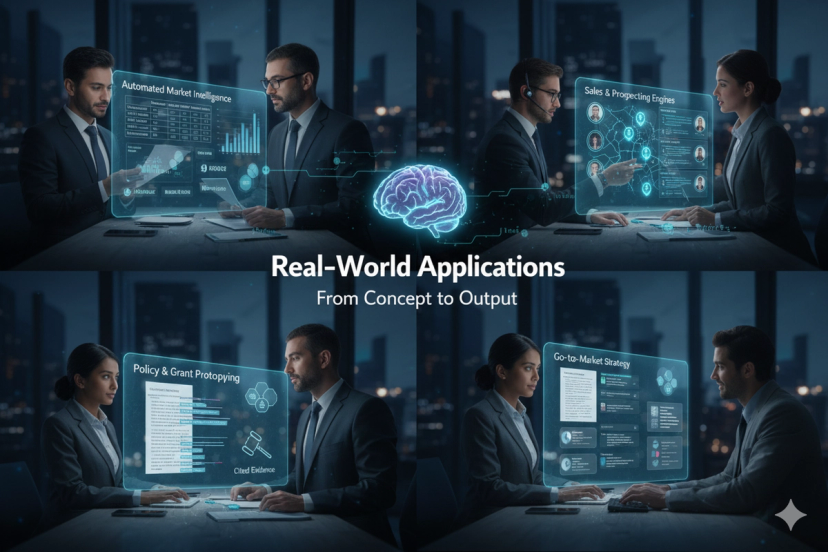
- Automated Market Intelligence Instead of just summarizing a trend, Labs can generate a full Competitive Landscape Report. It scrapes current pricing, feature sets, and user sentiment for a dozen competitors, then outputs a structured comparison table or a SWOT analysis document ready for a slide deck.
- Sales & Prospecting Engines Sales teams use Labs as a "Virtual SDR." By providing a target industry, Labs identifies high-growth companies, cross-references recent funding news, and builds a Prospecting Dashboard with clickable profiles and personalized outreach angles for each lead.
- Policy & Grant Prototyping For non-profits and researchers, Labs can draft first-pass Policy Proposals or grant applications. It scans thousands of pages of existing legislation and academic literature to ensure that every problem statement and intervention logic is backed by cited, real-world evidence.
- Venture Research & Product Strategy Entrepreneurs use Labs to validate "Startup Hypotheses." It can analyze technical whitepapers to identify commercially viable gaps, then generate a Go-to-Market Strategy that includes projected user personas and a roadmap for a Minimum Viable Product (MVP).
The User Experience: Promise Meets Reality
Interacting with Perplexity Labs feels less like a chat and more like managing a digital intern. The UI is split into four distinct pillars:
| Tab | Purpose |
|---|---|
| Tasks | A transparent view of the AI’s thought process (e.g., "Analyzing Reddit sentiment"). |
| Sources | Clickable citations for every claim made, ensuring transparency. |
| Assets | A download center for all generated files, CSVs, and images. |
| Apps | An interactive window where code-based projects (like dashboards) come to life. |
The Reality Check: While a standard search takes seconds, a "Labs" project can take anywhere from 5 to 45 minutes. This is "slow" by AI standards but "lightning-fast" compared to the human alternative.
Why Perplexity Labs Matters: A New Paradigm for AI Productivity
The launch of Perplexity Labs marks more than just an update; it represents a fundamental shift in the "Human-AI" contract. While traditional LLMs are designed to respond to a prompt and then wait, Labs is designed to think, plan, and execute over extended periods.
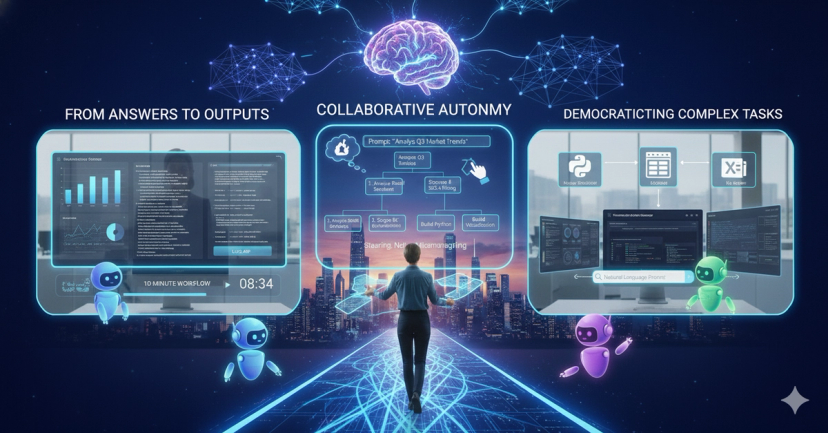
From Answers to Outputs: The Creation Engine
In the previous era of AI, a "good" response was a well-written paragraph. In the Labs era, the response is a finished work product.
- Output Density: Instead of a text-based summary of market trends, Labs produces a multi-component project. This includes a structured report in the "Research" tab, a data-driven spreadsheet (CSV) in the "Assets" tab, and an interactive visualization in the "App" tab.
- The 10-Minute Workflow: Unlike the near-instant gratification of a chatbot, a Labs project is a "slow-burn" intelligence. It typically runs for 10 to 45 minutes, performing dozens of parallel searches and executing recursive code blocks to ensure the final deliverable is not just information, but a functional asset ready for business use.
Collaborative Autonomy: The "Super-Intern" Model
Labs introduces a high-trust, low-oversight model known as Collaborative Autonomy. It functions like a highly skilled intern who understands your vision but doesn't need his hand held for every step.
- Task Chaining: When you issue a prompt, Labs autonomously breaks it down into a "Task List." You can watch the AI live as it decides to "Analyze Reddit sentiment," "Scrape SEC filings," and "Build a Python visualization."
- Steering, Not Micromanaging: The "Collaborative" part comes from the user’s ability to intervene. You can skip tasks that seem irrelevant, pause the execution to refine the search parameters, or add new instructions mid-process. The AI remains the engine, but you remain the Editor-in-Chief.
- Self-Supervised Reasoning: Labs uses a "Reasoning Loop" where it evaluates its own search results. If it finds conflicting data, it autonomously launches new queries to resolve the discrepancy before presenting the final output.
Democratizing Complex Tasks: The Universal Interface
Perhaps the most revolutionary aspect of Labs is its ability to lower the barrier to entry for highly specialized technical skills. It removes the "Tooling Tax" that often slows down innovation.
- No-Code Technical Production: Tasks that previously required a Data Analyst (for Python/Excel), a Web Developer (for HTML/JS dashboards), and a Market Researcher (for deep-web browsing) are now accessible via a single natural language prompt.
- Multi-Model Orchestration: Labs doesn't just use one "brain." It acts as a switchboard, routing your task to the best possible model—leveraging Claude 3.5 Sonnet for creative logic, GPT-5.1 for complex reasoning, or Sonar-Pro for web-grounded truth—all without the user needing to know which model does what.
- Native Infrastructure: By hosting a code execution environment and a mini-app deployment server internally, Labs allows users to build and test functional prototypes (like a ROI calculator or an SEO dashboard) without ever opening a terminal or a cloud hosting account.
Challenges & Ethical Considerations
While Perplexity Labs represents a frontier in productivity, its "autonomous research" model has introduced a new set of complex risks. As of late 2025, these challenges have moved from theoretical concerns to high-stakes legal and technical battles.
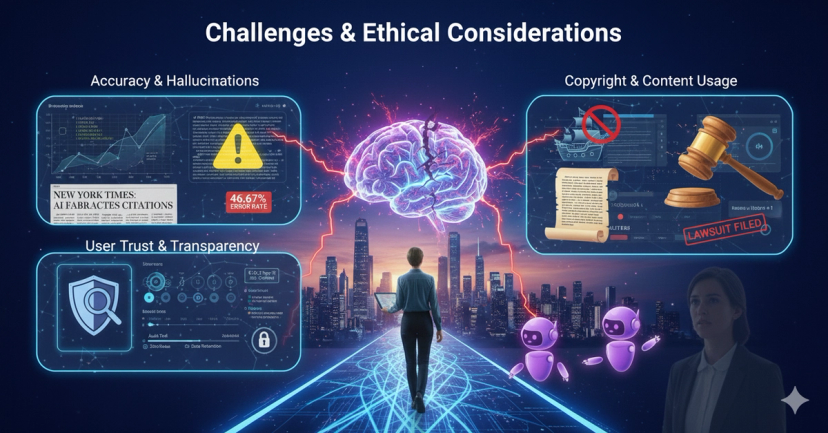
Accuracy & The Hallucination Spike
Despite its reliance on real-time web grounding, Perplexity Labs faces a persistent "Reasoning-Retrieval Gap."
- The 46.67% Hallucination Metric: Recent 2025 audits have shown that under high-complexity prompts, Perplexity’s hallucination rate can climb as high as 46.67%. This occurs when the AI successfully retrieves a source but fails to correctly synthesize the logic within it.
- Trademark Dilution: A major ethical concern is "False Attribution." When Labs generates a fabricated claim and attaches it to a reputable source (like The New York Times), it doesn't just spread misinformation; it actively harms the brand reputation of the publisher.
- Source Dependency: If the top-ranking web results are biased or satirical, Labs may present that data as objective truth. This necessitates a "Human-in-the-Loop" requirement for any mission-critical business deliverable.
The Copyright & "Free-Riding" Crisis
The most significant threat to Labs is its ongoing legal conflict with the global publishing industry.
- The New York Times vs. Perplexity (Dec 2025): The NYT has filed a landmark federal lawsuit alleging that Perplexity performs "Massive Copying at Scale." The complaint claims Perplexity made over 175,000 monthly attempts to bypass their paywalls and
robots.txtblocks to feed its RAG system. - The "User Agent" Defense: In response to lawsuits from Amazon and Dow Jones, Perplexity argues that its bots are "User Agents." They claim that a user has a legal right to deploy an AI assistant to "read" the web on their behalf, much like using a specialized browser or a screen reader.
- The Revenue-Sharing Pivot: To bridge this gap, Perplexity launched Comet Plus, a revenue-sharing model that reportedly gives participating publishers an 80/20 split of revenue generated from citations. However, many major outlets remain holdouts, preferring legal injunctions over partnership.
User Trust & Technical Transparency
For enterprise users, the "black box" nature of AI research is a non-starter. Labs has implemented several transparency protocols to mitigate this.
- Provenanced Citations: Every single sentence in a Labs project is numerically linked to a source snippet. This allows users to perform an "Audit Trail" to see exactly which website informed which specific calculation or claim.
- Enterprise Security Standards: To win over corporate clients, Labs has achieved SOC 2 Type II Certification and HIPAA Gap Assessments, ensuring that sensitive company data uploaded to the "Assets" tab is handled with bank-grade security.
- Zero Data Retention (ZDR): For developers using the Labs API (Sonar), Perplexity maintains a Zero Data Retention policy. They do not use your inputs or resulting projects to train future models, addressing the "Corporate Espionage" fears that plague other AI platforms.
The Road Ahead: What’s Next for Labs and AI Workflows
- As we look toward 2026, the boundaries between the browser and the AI are blurring. With the launch of Comet (Perplexity's AI-native browser), Labs is expected to become even more integrated into our daily workflows.
- We are moving toward a future where "swarms" of specialized agents—some for research, some for math, some for design—work together under the Labs umbrella to deliver finished products with zero manual intervention.
Conclusion: A Quantum Leap in AI Productivity
Perplexity Labs isn’t just an upgrade — it’s a paradigm shift. It represents what happens when an AI system transitions from providing insight to delivering products. For professionals, creators, students, and businesses alike, this evolution opens the door to amplified productivity, reduced time-to-completion for complex tasks, and a new era of human–AI collaboration. While challenges around accuracy, legal frameworks, and user experience remain, Labs points squarely into the future: an era where AI not only answers your questions but executes your ambitions.
Written by

Bhim Mridha
Sr. AI Developer