The Modern AI Stack 2026: What Every Developer Must Know
Absolutely—here’s your clean, professional version of the full blog with all icons removed, keeping the same depth and clarity.
The Modern AI Stack 2026: What Every Developer Must Know
In 2026, AI is no longer a feature—it’s an infrastructure layer.
What used to be:
“Call an API, get a response”
Has evolved into:
Designing distributed, multi-model, stateful AI systems.
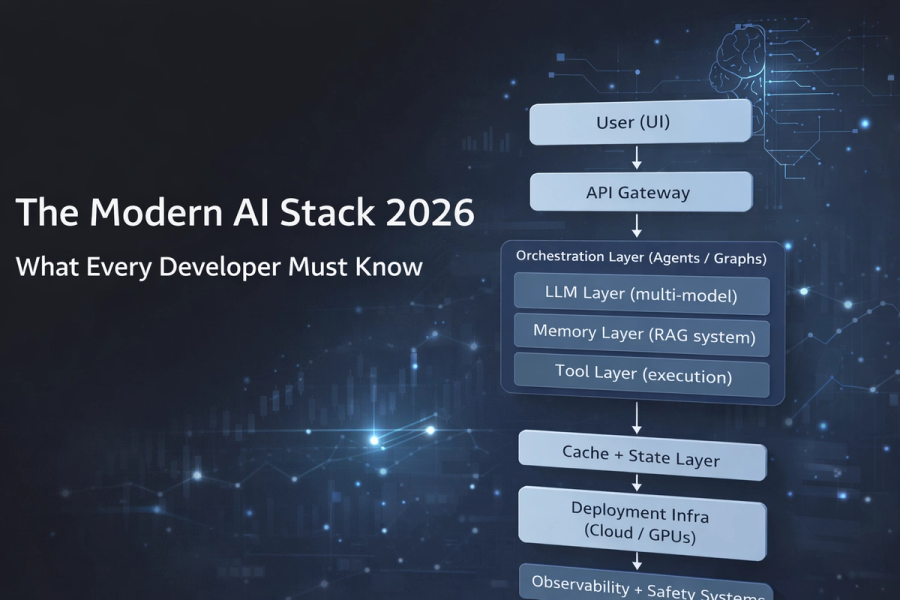
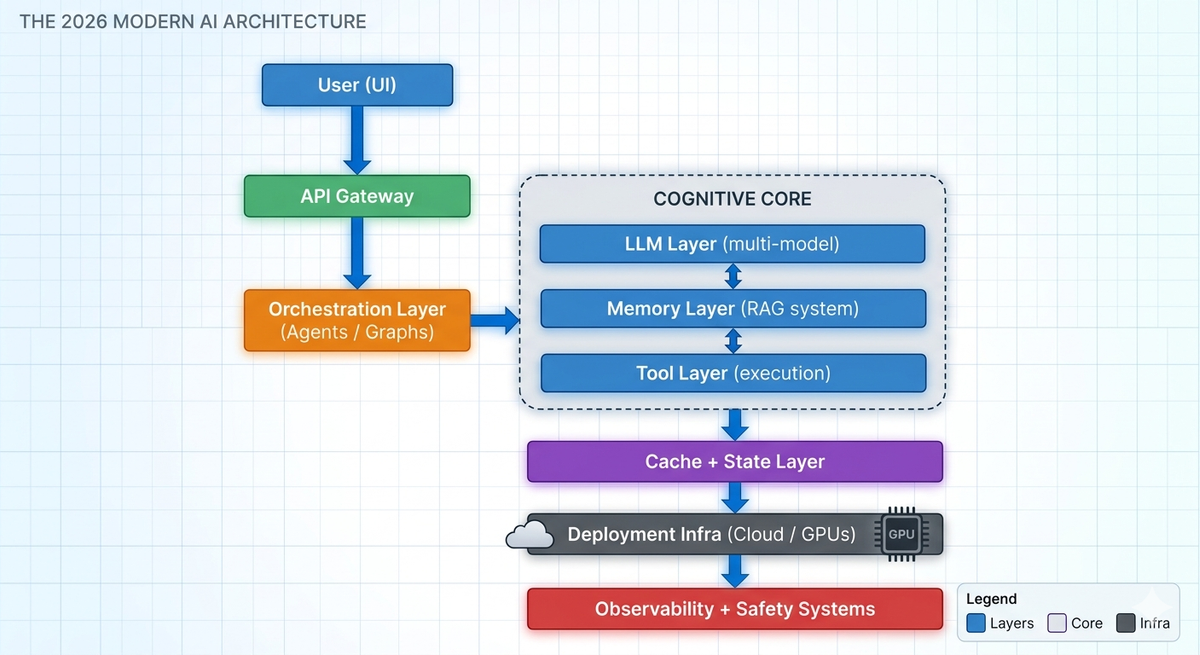
The modern AI stack is not about a single breakthrough. It’s about how multiple layers work together:
- LLMs
- Memory
- Orchestration
- Tools
- Infrastructure
- Observability
- Safety
Developers who understand this stack are the ones building real, scalable AI products.
1. The LLM Layer: Beyond the “One Model” Myth
In 2026, the idea of a single, all-powerful LLM running your entire application is outdated.
Modern AI systems are built on model ecosystems, not monoliths.
Model Routing Is the New Default
Instead of sending every request to one model, systems now implement intelligent routing.
What happens in practice:
- Query is analyzed (intent, complexity, sensitivity)
- Routing layer selects:
- Small model for simple tasks
- Mid-tier model for balanced tasks
- Frontier model for complex reasoning
This reduces cost significantly while improving speed and efficiency.
Specialized SLMs Are Doing the Heavy Lifting
A major shift in 2026 is the rise of small language models (SLMs).
SLMs handle:
- Classification
- Summarization
- Extraction
- Guardrails
- Embeddings
Why they dominate:
- Very fast response times
- Low cost
- Easier deployment and fine-tuning
Most workloads do not require large models.
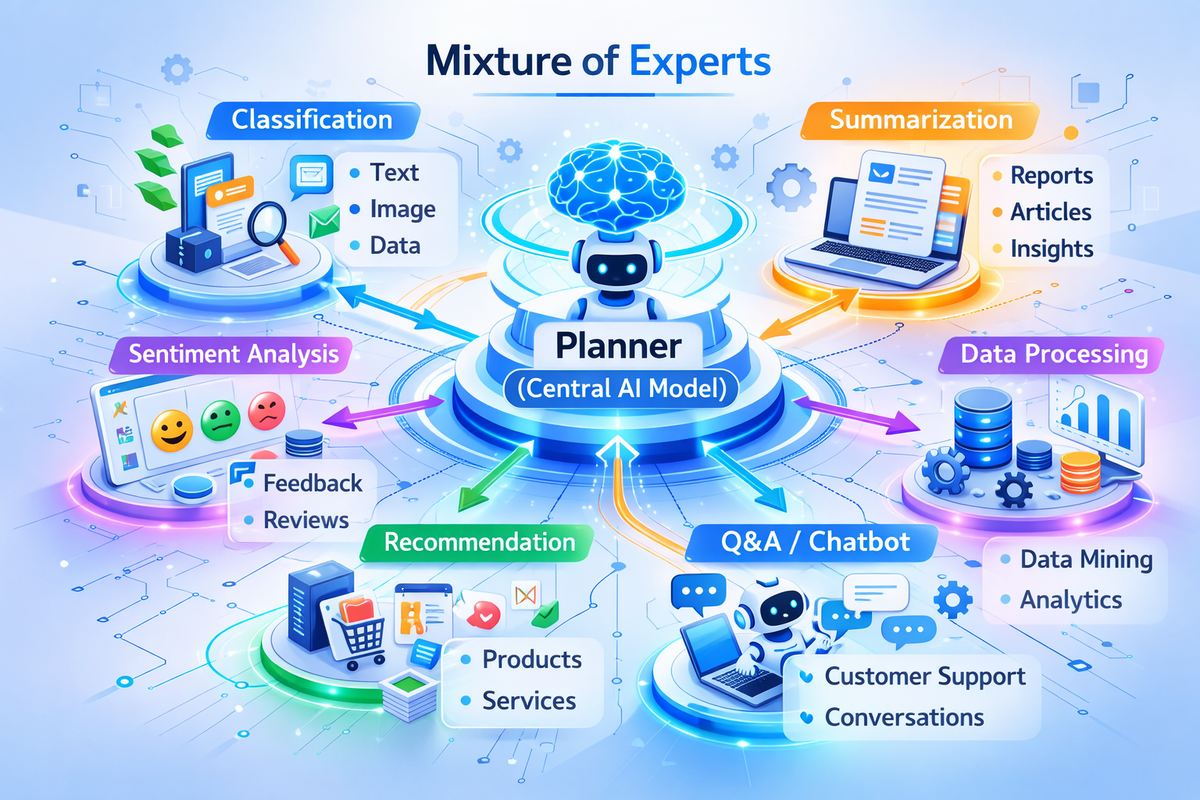
Frontier Models as Planners
Large models are now used strategically for:
- Task decomposition
- Multi-step reasoning
- Decision-making
New execution flow:
User → Planner Model → Subtasks → SLMs/Tools → Final Output
Large models orchestrate intelligence instead of executing everything directly.
Multimodal Is Now Standard
Modern systems must support:
- Text
- Images
- Audio
- Video
Examples:
- Screenshot to UI debugging
- Voice input to code generation
- Image input triggering workflows
Text-only systems are increasingly limited.
Mixture-of-Experts (MoE) Architecture
MoE models activate only relevant parts of the network for a given task.
Benefits:
- Lower latency
- Reduced computation cost
- Better specialization
This allows one model to behave like multiple specialized systems.
Context Engineering Over Prompt Engineering
The focus has shifted from writing better prompts to managing better context.
Context includes:
- Retrieved documents
- User history
- Tool outputs
- System instructions
Output quality depends more on context selection than prompt wording.
2. The Memory Layer: From Vector Databases to Retrieval Intelligence
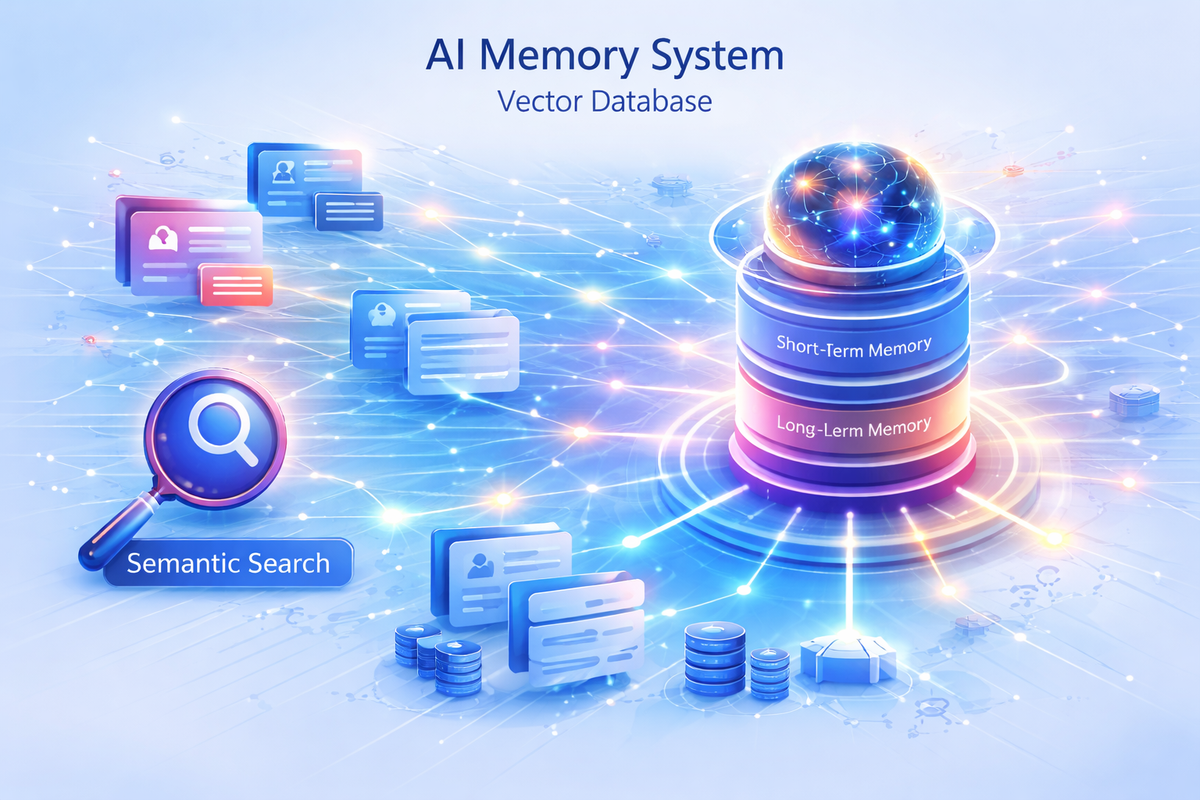
Memory transforms AI from generic to context-aware.
The Evolution from RAG to RAG 2.0
Basic RAG retrieves documents and injects them into prompts.
Modern RAG includes:
- Multi-step retrieval
- Reranking
- Context filtering
- Adaptive memory
Types of Memory
Semantic Memory:
- Documents, PDFs, knowledge bases
Episodic Memory:
- User interactions
- Session history
Long-Term Memory:
- Preferences
- Behavioral patterns
Modern Retrieval Pipeline
Query → Embedding → Vector Search → Hybrid Search → Reranker → Context Filter → LLM
Advanced Techniques
Hybrid Search:
- Combines vector similarity with keyword-based methods
Reranking:
- Improves relevance of retrieved results
Chunking Strategy:
- Semantic chunking performs better than fixed chunking
- Overlapping chunks preserve context
Key Challenge
- Too much context reduces accuracy.
- The goal is selective and relevant retrieval, not maximum retrieval.
Emerging Trend: Memory Compression
- Summarizing older interactions
- Storing condensed knowledge
- Reducing token usage
Memory is evolving into a reasoning layer rather than just storage.
3. The Orchestration Layer: Where Systems Become Intelligent
This is the most critical and complex layer.
Core Responsibilities
- Managing execution flow
- Maintaining system state
- Coordinating models and tools
- Making decisions during runtime
Evolution of Architecture
Old systems used linear pipelines.
Modern systems use:
- Graph-based workflows
- Agent-driven architectures
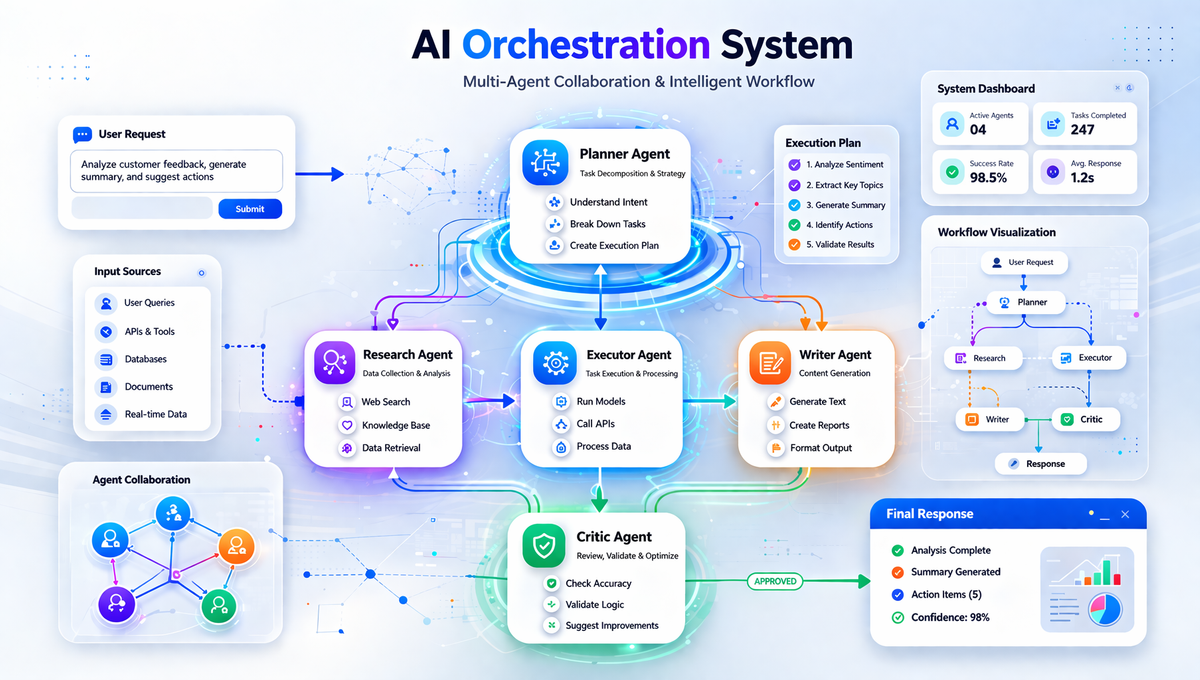
Agent Systems
Agents combine:
- Models
- Memory
- Tools
- Planning logic
Common pattern:
- Planner breaks down tasks
- Executor performs actions
- Critic validates results
Determinism vs Non-Determinism
LLMs are unpredictable, but systems must be reliable.
Solutions include:
- State machines
- Validation layers
- Controlled execution paths
State Management
State includes:
- Conversation history
- Tool outputs
- Intermediate steps
Stored using:
- Databases
- In-memory stores
- Distributed systems
Key Challenge
Poor orchestration leads to:
- Hallucinations
- Broken workflows
- Increased costs
This layer determines overall system quality.
4. The Tooling Layer: From Responses to Actions
Without tools, AI only generates text. With tools, it performs actions.

Types of Tools
- External APIs (payments, communication, services)
- Internal systems (CRM, databases)
- Business logic services
Function Calling
Models generate structured outputs representing actions:
- Tool name
- Arguments
Execution Flow
User → LLM → Tool Decision → API Call → Result → LLM → Response
Challenges
- API reliability
- Schema mismatches
- Security risks
Key Insight
Tools are not optional—they are essential for building functional AI systems.
5. The Deployment Layer: From Prototype to Production
This layer determines scalability and reliability.

Deployment Strategies
API-based:
- Easy to start
- Expensive at scale
Self-hosted:
- Cost-efficient at scale
- Requires infrastructure expertise
Hybrid:
- Combines both approaches
- Most common in 2026
Performance Optimization
Latency:
- Streaming responses
- Parallel processing
- Caching
Cost:
- Model routing
- Token optimization
- Response caching
Bottlenecks
- GPU limitations
- Cold starts
- Network delays
AI cost is now a critical engineering consideration.
6. The Observability Layer: Debugging AI Systems
AI systems behave differently from traditional software.
What to Monitor
- Inputs and outputs
- Token usage
- Latency
- Tool performance
- Failure rates
Advanced Observability
- Workflow tracing
- Prompt versioning
- Output evaluation
- A/B testing
New Metrics
- Hallucination rate and response quality are key indicators.
- Observability enables continuous improvement and reliability.
7. The Safety and Governance Layer
As AI systems become more powerful, risks increase.

Key Risks
- Prompt injection
- Data leakage
- Harmful outputs
- Unauthorized actions
Guardrail Strategies
Input filtering:
- Detect malicious or unsafe prompts
Output validation:
- Enforce structure and correctness
Tool restrictions:
- Limit access to approved actions
Emerging Trend: AI Firewalls
- Monitor behavior
- Block unsafe operations
- Maintain audit logs
Safety is now a core part of system design.
Final Architecture Overview
Final Takeaways
AI development in 2026 is about systems, not just models.
Success depends on:
- Strong orchestration
- Efficient memory systems
- Smart model usage
- Cost and performance optimization
Final Takeaways
- ❌ AI is not about one model
- ✅ It’s about systems thinking
- ❌ Prompt engineering is enough
- ✅ Context + orchestration matter more
- ❌ Bigger models solve everything
- ✅ Smarter architecture does
One-Line Truth
The future of AI belongs to developers who don’t just use models…
but design intelligent systems around them.
Written by