Supabase vs Firebase (2026): Which Backend-as-a-Service Should You Choose?
In modern app development, speed and scalability matter more than ever. That’s why Backend-as-a-Service (BaaS) platforms like Supabase and Firebase are gaining massive popularity.
Instead of building backend infrastructure from scratch, developers can use these platforms to handle:
- Databases
- Authentication
- Storage
- APIs
- Realtime updates
But the big question is:
Should you choose Supabase or Firebase?
This guide will break down everything—from architecture to pricing—so you can make the right decision.
What is Supabase?
Supabase is an open-source BaaS that provides all the features of a backend (Database, Auth, Storage, Edge Functions) by wrapping them around PostgreSQL.
Key Features:
- PostgreSQL database (SQL-based)
- Realtime subscriptions
- Built-in authentication
- Storage system
- Edge Functions
- Row Level Security (RLS)
Philosophy
Supabase focuses on:
- Open-source ecosystem
- Developer control
- SQL-first approach
If you love SQL and transparency, Supabase feels natural.
What is Firebase?
Firebase is a comprehensive mobile and web application development platform. It offers a suite of tools that go beyond just a backend, including analytics, remote config, and crash reporting
Key Features:
- Firestore (NoSQL database)
- Realtime Database
- Authentication
- Cloud Functions
- Hosting
- Analytics integration
Philosophy
Firebase focuses on:
- Speed
- Scalability
- Plug-and-play backend
It’s especially popular for mobile and real-time apps.
Core Feature Comparison
| Feature | Supabase | Firebase |
| Database | PostgreSQL (SQL) | Firestore (NoSQL) |
| Realtime | Yes | Yes |
| Auth | GoTrue (Postgres-native, RLS-integrated) | Firebase Auth (Mature, Social, Phone) |
| Storage | Yes | Yes |
| Hosting | Limited | Advanced |
| Open Source | Yes | No |
| Vendor Lock-in | Low | High |
Architecture Difference: SQL vs. NoSQL
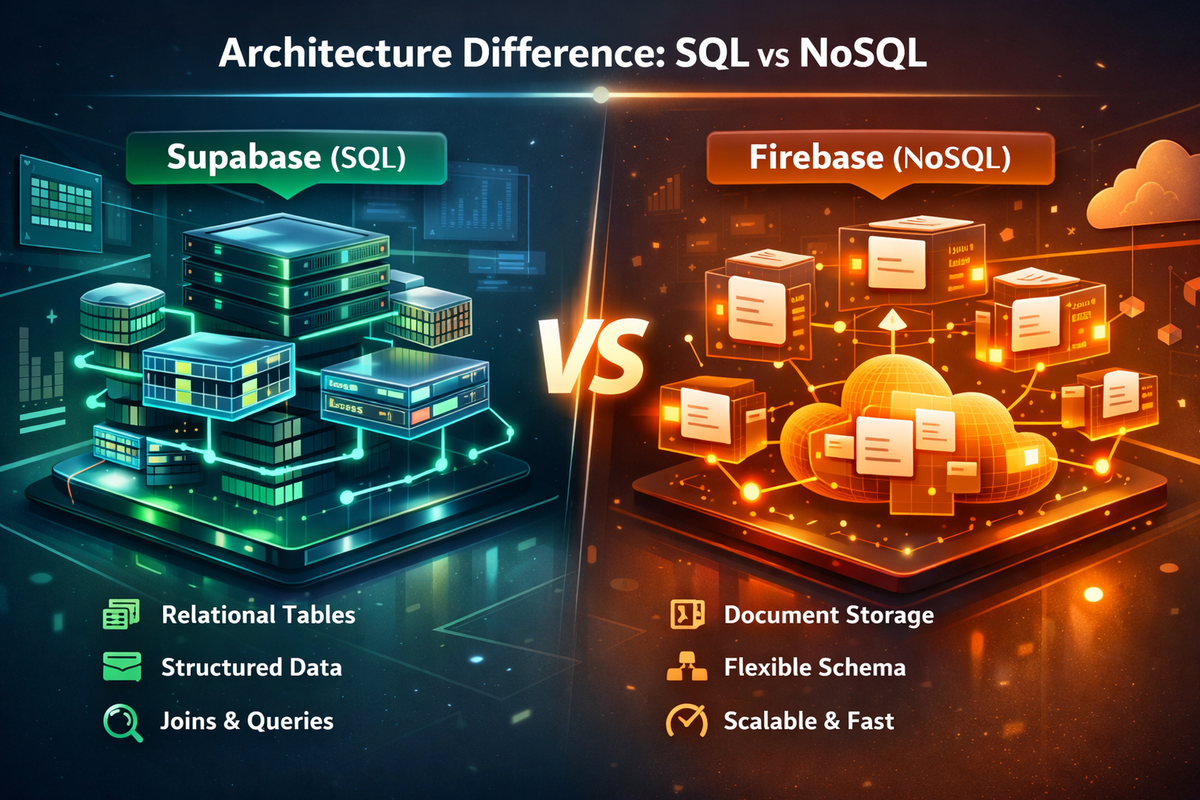
Supabase: The Relational Powerhouse
Supabase uses PostgreSQL. This means you have:
- Tables & Joins: Querying related data (e.g., getting a "Post" and its "Author") is native and efficient.
- Strict Schemas: Your data must follow rules, preventing "corrupt" data from entering your DB.
- Extensions: Access to the Postgres ecosystem, including pg_vector for storing AI embeddings.
Firebase: The Flexible Document Store
Firebase uses Cloud Firestore, a NoSQL document database.
- Collections & Documents: Data is stored in JSON-like structures.
- Schemaless: You can store different fields in different documents within the same collection.
- Scalability: Firestore is designed for massive, horizontal scale but makes complex relationships harder to manage (often requiring data duplication).
Performance & Scalability
- Firebase: Excel at "shallow" reads across billions of documents. If you have 10 million users and each just needs to read their own profile, Firebase is unbeatable. However, complex "deep" queries (aggregations, multi-collection filtering) can become slow and expensive.
- Backed by Google infrastructure
- Handles massive scale effortlessly
- Global CDN and low latency
- Supabase: Offers predictable performance for complex relational data. In 2026, Supabase’s Read Replicas allow you to scale your database globally, though it requires more thought into database indexing and optimization than Firebase's "auto-managed" approach
- Scalable, but depends on setup
- Improving rapidly
- More control over performance tuning
Verdict: Firebase wins in massive scale, Supabase offers more control.
Pricing Comparison
Supabase
- Generous free tier
- Transparent pricing
- Predictable costs
Firebase
- Free tier available
- Pay-as-you-go
- Can become expensive unexpectedly
Hidden Cost Alert:
Firebase billing can spike due to:
- Reads/writes
- Network usage
Winner: Supabase (more predictable pricing)
Authentication & Security
Supabase
- Row Level Security (RLS)
- SQL-based access control
- Fine-grained permissions
Firebase
- Security Rules (JSON-based)
- Flexible but complex
Verdict:
- Supabase = powerful & structured
- Firebase = flexible but tricky
Developer Experience (DX) & AI
In 2026, DX is defined by AI integration.
- Supabase MCP (Model Context Protocol): Supabase has taken the lead here. You can connect your DB schema directly to AI IDEs (like Cursor or Claude). The AI "sees" your tables and can write perfect SQL or migrations for you.
- Firebase Genkit: Google has integrated Gemini deeply into the Firebase console. It can help you write security rules and generate cloud functions based on natural languag
Use Cases: When to Use What?
Choose Supabase if
- You are building a SaaS, Fintech, or ERP where data integrity and relationships are vital.
- You want to avoid vendor lock-in (you can export your Postgres DB anytime).
- You prefer SQL over JSON-based logic.
- You need to perform Vector Search for AI features.
Choose Firebase if
- You are building a Mobile App (iOS/Android) where offline-first is a requirement.
- You need fast prototyping and don't want to worry about database schemas.
- You are already heavily invested in the Google Cloud ecosystem.
- You need advanced features like Remote Config or A/B Testing out of the box.
Real-time Capabilities
- Firebase: Built from the ground up for real-time. The SDK handles offline-persistence brilliantly. If a user loses internet, they can still "write" data; Firebase syncs it automatically once they are back online.
- Supabase: Uses Postgres CDC (Change Data Capture). It is excellent for web apps (chat, dashboards), but its mobile offline-syncing capabilities still lag slightly behind Firebase's mature mobile SDKs
Real-World Examples
Supabase Use Cases
- SaaS dashboards
- Admin panels
- Data-heavy applications
Firebase Use Cases
- Chat applications
- Social apps
- Mobile apps
Final Verdict
In 2026, the gap has closed, but the "soul" of the platforms remains different.
Supabase is for the "Database Professional" who wants a modern, open-source stack that grows into a sophisticated backend. Firebase is for the "Product Developer" who wants to treat the backend as a utility so they can focus entirely on the frontend and user experience.
Our Recommendation: If you are building for the web or a complex SaaS, start with Supabase. If you are building a high-engagement mobile social app, Firebase is still the safer bet.
Written by