Specialized AI Teams Outperform Generalists: Building Multi-Agent Systems

The Monolithic LLM Bottleneck: Why Generalists Fail Complex Tasks
Relying on a single, general-purpose large language model (LLM) for complex, multi-faceted tasks often leads to suboptimal outcomes. While impressive for broad queries, these monolithic systems struggle with deep, specialized reasoning, context switching across diverse domains, and maintaining factual consistency over extended interactions. The inherent limitations of a single context window and the tendency for 'context soup' dilute performance, resulting in higher hallucination rates and an inability to consistently execute multi-step workflows requiring distinct expertise.
Consider a scenario where an LLM is asked to research a market trend, analyze financial reports, and then draft an executive summary. A single LLM attempting this often gets bogged down, producing superficial research, making errors in data interpretation, or generating generic summaries. This isn't a failure of the LLM's raw intelligence, but rather a misapplication of its generalist nature to a problem requiring specialized skills. The cost-per-token also becomes a significant factor; asking a powerful, expensive model to perform simple data extraction is inefficient.
The counter-intuitive truth is that simply feeding a larger prompt or providing more context to a single LLM often exacerbates the problem, increasing token costs and computational load without a proportional gain in quality. Instead, the solution lies in decomposition: breaking down a complex problem into smaller, manageable sub-tasks, each handled by an AI agent specifically designed and equipped for that particular job. This mirrors how human teams tackle intricate projects, leveraging diverse expertise rather than relying on a single polymath.
Multi-Agent Systems: Orchestrating Specialized AI Workers
Multi-agent systems represent a paradigm shift in how we build sophisticated AI applications, moving beyond the 'one-model-fits-all' approach. Instead of a single LLM attempting every task, these systems employ an orchestrated network of specialized AI agents, each assigned a distinct role, equipped with specific tools, and operating under defined protocols. This architecture emulates a human project team, where a manager delegates tasks to experts like a researcher, data analyst, or technical writer, each contributing their unique skill set to the collective goal.
At its core, a multi-agent system comprises several key components: an orchestrator or manager agent that oversees the overall workflow, specialized worker agents focused on particular tasks, a shared memory or knowledge base, and a suite of tools (APIs, databases, code interpreters) that agents can access. The orchestrator's role is critical; it interprets the user's high-level request, breaks it down into sub-tasks, assigns them to the most appropriate worker agents, and synthesizes their outputs into a coherent final response.
This specialization yields substantial benefits. By limiting each agent's scope, the LLM within that agent can be fine-tuned or prompted more precisely for its specific function, reducing the likelihood of hallucinations and improving accuracy. Furthermore, debugging becomes significantly easier, as issues can often be traced back to a particular agent or its interaction protocols. The modularity also allows for more efficient resource allocation, potentially using smaller, cheaper models for simpler tasks and reserving larger, more capable models for complex reasoning within specialized agents.
Architecting Agentic Workflows: Key Components and Roles
Building effective multi-agent systems requires careful consideration of architecture and interaction patterns. The foundational elements include a central orchestrator, multiple worker agents, a communication bus, and a robust set of tools. The orchestrator, often powered by an LLM, acts as the project manager, understanding the overarching objective, planning the execution sequence, and delegating tasks. It monitors progress, handles conflicts, and integrates the results from various worker agents to form a cohesive output.
Worker agents are the specialists, each designed for a specific domain or task. Examples include a 'Search Agent' capable of using tools like Google Search or internal knowledge bases, a 'Code Interpreter Agent' that can execute Python code for data manipulation or complex calculations, a 'Data Analyst Agent' adept at querying databases and identifying trends, or a 'Content Generation Agent' focused on drafting human-readable summaries. Each worker agent is typically a smaller, focused LLM instance (or even a traditional software module) paired with domain-specific tools and instructions.
Communication between agents is paramount. This can range from simple message passing to shared memory structures or a blackboard system where agents post and retrieve information. Frameworks like LangChain's AgentExecutor, CrewAI, and AutoGen provide abstractions for defining agent roles, tools, and communication patterns, simplifying the development process. These frameworks enable developers to define a 'crew' of agents, assign them specific goals, and let them autonomously collaborate to achieve complex objectives, often with a 'hierarchical' or 'peer-to-peer' communication model.
Real-World Impact: Enhancing Enterprise Data Analysis
Consider a financial services firm struggling with the manual effort and inconsistency of market research and investment analysis. A monolithic LLM might provide general insights but lacks the precision and depth required for critical financial decisions. By implementing a multi-agent system, the firm transformed its analytical capabilities, significantly reducing time-to-insight and improving the accuracy of its reports. This system was designed to automate several stages of the research and analysis pipeline, previously a bottleneck for human analysts.
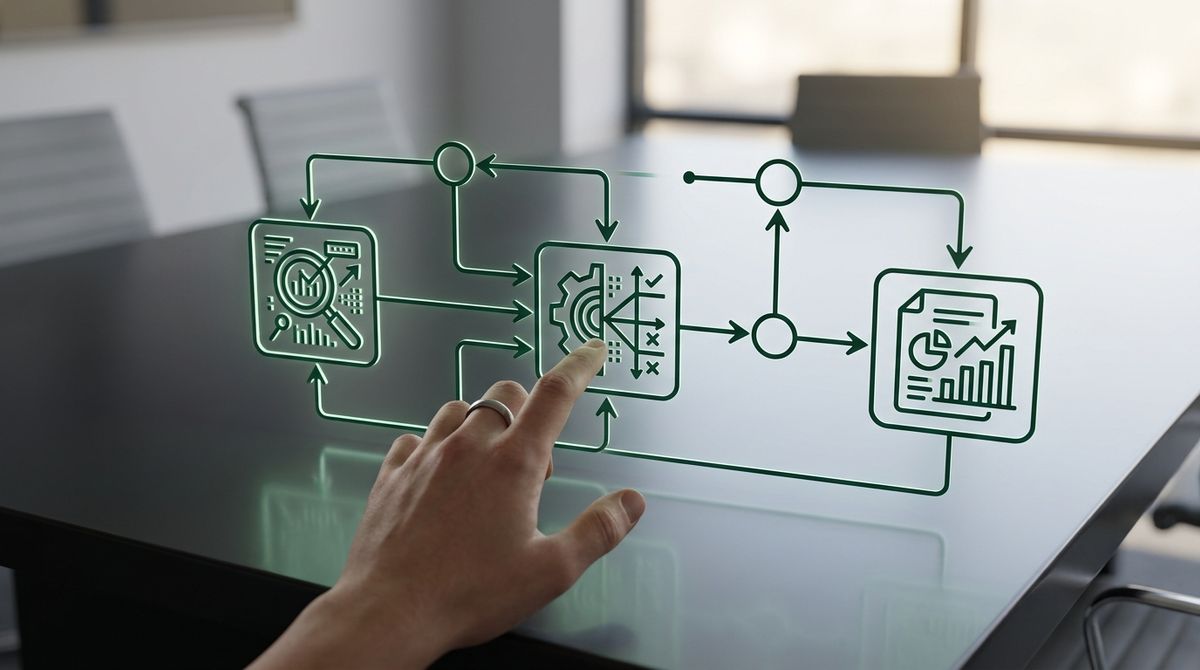
The deployed system featured a 'Research Agent' equipped with access to financial databases, market news APIs, and proprietary internal reports. This agent's role was to gather relevant data, identify key trends, and flag significant events. Its output was then passed to a 'Data Processing Agent' that cleansed, structured, and normalized the information, preparing it for quantitative analysis. This agent utilized Python scripts and statistical libraries to ensure data integrity and consistency, a task where generalist LLMs frequently introduce errors.
Subsequently, an 'Analysis Agent' took the processed data, running predefined models and statistical tests to identify patterns, evaluate investment opportunities, and assess risks. Finally, a 'Report Generation Agent' synthesized these findings, drafting comprehensive, tailored reports for different stakeholders, from portfolio managers to executive leadership. This agent focused on clarity, conciseness, and adherence to corporate style guides. The entire workflow, which previously took days of manual effort, was reduced to hours, with significantly higher accuracy and reproducibility, directly impacting investment strategy and decision-making.
The Trade-offs of Agentic Complexity: Cost, Latency, and Management
While multi-agent systems offer compelling advantages, they introduce inherent trade-offs that engineering leaders must carefully weigh. The primary concern is increased system complexity. Managing multiple interacting agents, their individual states, communication protocols, and tool access requires a more sophisticated architectural design compared to a single LLM API call. Debugging becomes more intricate, as issues can arise from individual agent misbehavior, communication failures, or orchestration logic errors, demanding robust logging and tracing capabilities.
Operational costs can also be higher. While individual worker agents might use smaller, cheaper LLMs for specific tasks, the sheer number of LLM calls across multiple agents and their interactions can accumulate. Each step in a multi-agent workflow, from initial delegation to final synthesis, typically involves a separate LLM invocation. This necessitates careful cost optimization, potentially through caching, intelligent routing to different model sizes (e.g., GPT-3.5 for simple parsing, GPT-4 for complex reasoning), or leveraging open-source alternatives for specific agents.
Latency is another critical consideration. Agentic workflows are often sequential, with tasks passed from one agent to the next. While some parallelization is possible, the cumulative execution time of multiple steps can lead to higher end-to-end latency compared to a single, direct LLM query. Furthermore, designing effective communication and coordination between agents requires significant prompt engineering expertise to ensure clarity, prevent ambiguity, and avoid infinite loops or conflicting instructions, adding to development time and maintenance overhead. These trade-offs underscore that multi-agent systems are best suited for problems where the gains in accuracy, reliability, and automation significantly outweigh the added complexity and operational overhead.
Designing Your First Multi-Agent System: A Practical Checklist
Embarking on a multi-agent system project requires a structured approach to ensure success and manage complexity. Begin by clearly defining the problem you aim to solve. Is it truly multi-step and specialized, or could a simpler RAG system suffice? Multi-agent systems shine where diverse expertise, tool use, and sequential reasoning are critical, and where a single LLM frequently fails or produces unreliable results. Avoid over-engineering; start with the minimum viable set of agents and tools.
Once the problem is clear, meticulously map out the workflow. Decompose the overarching goal into distinct sub-tasks that can be handled by individual specialists. Each identified role should have a clear scope, defined inputs, expected outputs, and a set of tools it can reliably use. This upfront design prevents agents from stepping on each other's toes or attempting tasks for which they are not equipped. Iterate on this design, simulating the workflow mentally or with basic prototypes before committing to full implementation.
- Define the complex problem: Ensure it requires multi-step reasoning and specialized knowledge.
- Identify distinct roles: Envision human 'experts' needed for each sub-task.
- Assign tools: Specify the APIs, databases, or functions each agent can access.
- Establish communication protocols: Determine how agents share information and hand off tasks.
- Choose an orchestration framework: Evaluate options like LangChain, CrewAI, or AutoGen based on project needs.
- Implement robust monitoring and logging: Essential for debugging and performance analysis.
- Iterate and refine: Start with a simple prototype and gradually add complexity.
Beyond Prompt Engineering: Agent-Centric Evaluation
Evaluating multi-agent systems extends beyond traditional prompt engineering metrics. While individual agent performance is important, the true measure of success lies in the system's ability to achieve the end-to-end task goal reliably and efficiently. This requires comprehensive evaluation strategies that consider the interplay between agents, the effectiveness of their communication, and the robustness of the orchestration logic. Simply checking an LLM's output for coherence is insufficient; the entire workflow must be validated against real-world scenarios.
Key evaluation metrics should include overall task success rate, accuracy of the final output, latency of the entire workflow, and cost per task. Furthermore, it is crucial to analyze failure modes: where did the workflow break down? Was it a misinterpretation by an agent, a tool malfunction, or a communication error? Tools for visualizing agent interactions and tracing decision paths become invaluable for diagnosing and improving system performance. Testing edge cases and adversarial inputs is also critical to ensure the system's resilience and prevent unexpected behaviors in production.
Next Steps: Piloting Your Specialized AI Workforce
To leverage the power of multi-agent systems, begin by identifying a specific, high-value problem within your organization where current monolithic LLM solutions or manual processes are demonstrably inefficient, inaccurate, or costly. Prioritize a pilot project with a contained scope, allowing for iterative development and clear measurement of success. Look for tasks that involve distinct stages, require access to multiple external tools or data sources, and benefit from specialized reasoning, such as advanced data extraction, complex report generation, or multi-stage customer inquiry resolution.
Once a suitable pilot is identified, assemble a small team to define the agent roles, their required tools, and communication patterns. Consider leveraging existing frameworks like LangChain or CrewAI to accelerate development, rather than building everything from scratch. Focus on establishing clear success criteria, such as a measurable increase in output accuracy, a reduction in processing time, or a decrease in operational costs. By starting small, measuring rigorously, and iterating rapidly, organizations can effectively transition from generalist LLM applications to powerful, specialized multi-agent systems, unlocking new levels of automation and intelligence.
Written by