Model Context Protocol: Standardizing LLM Tool Use for Enterprise AI

The Hidden Costs of Ad-Hoc LLM Tooling
Many organizations building advanced LLM applications discover that the initial promise of powerful AI agents quickly devolves into a complex, brittle integration challenge. The current paradigm for integrating LLMs with external tools often relies on ad-hoc prompt engineering or custom wrappers, leading to a patchwork of bespoke solutions. Each new tool or API requires a fresh approach to instruction tuning, context formatting, and error handling, creating significant technical debt. This fragmented landscape severely limits the scalability and reliability of AI-driven workflows, especially in mid-market and enterprise environments where system heterogeneity is the norm.
The challenges manifest in several critical areas. LLMs, despite their reasoning capabilities, are prone to 'tool hallucination' when tool specifications are ambiguous or inconsistent, leading to attempts to call non-existent functions or misinterpret valid outputs. Context window limitations mean developers constantly battle to provide enough information for accurate tool selection and execution without overflowing the model. Furthermore, debugging and maintaining these custom integrations become a nightmare, as changes in upstream APIs or LLM behavior can silently break entire workflows, demanding extensive manual oversight and frequent, costly revisions. The lack of a standardized contract between the LLM and its tools is the root cause.
These integration headaches are not mere inconveniences; they translate directly into tangible costs. Development cycles are extended, as engineers spend disproportionate amounts of time on glue code and error recovery rather than core business logic. Operational expenses rise due to increased monitoring, manual intervention, and the need for specialized prompt engineers. More critically, inconsistent or unreliable AI agent performance erodes user trust, leading to low adoption rates for promising AI solutions. This prevents organizations from realizing the true ROI of their AI investments, trapping them in a cycle of incremental, fragile improvements rather than scalable, robust automation.
Introducing the Model Context Protocol (MCP)
The Model Context Protocol (MCP) emerges as a critical advancement, providing a standardized contract for how Large Language Models interact with external tools and data sources. At its core, MCP defines explicit schemas for tool capabilities, input parameters, expected outputs, and error handling mechanisms. This structured approach moves beyond heuristic prompt engineering, establishing a programmatic interface that allows LLMs to understand, select, and execute tools with unprecedented precision. Instead of inferring tool use from natural language descriptions, LLMs are presented with a clear, machine-readable blueprint of available functionalities.
MCP operates by formalizing the 'tool description' that an LLM receives. It specifies how tools declare themselves to the LLM agent, including their names, descriptions, required arguments, and data types. This structured metadata empowers the LLM to make more informed decisions about which tool to invoke and how to format its inputs correctly. Furthermore, MCP outlines how tool outputs should be returned to the LLM, ensuring consistent parsing and integration into the ongoing conversational or reasoning context. This abstraction layer significantly reduces the cognitive load on the LLM and the development complexity for engineers, streamlining the entire tool-use pipeline.
The distinction between MCP and existing methods is crucial. While frameworks like LangChain and LlamaIndex provide abstractions for tool integration, MCP aims to establish a universal, interoperable standard at a lower level. It's less about a specific library implementation and more about the underlying data format and communication pattern. By adopting a common protocol, organizations can ensure that tools developed by different teams or even different vendors can seamlessly integrate into various LLM-powered applications. This fosters a more modular and composable AI ecosystem, where tools are truly plug-and-play, rather than requiring custom adaptation for each new LLM or agent framework.
Key Benefits: Reliability, Scalability, and Reduced Hallucinations
The primary advantage of adopting MCP is a dramatic improvement in the reliability of LLM-powered applications. By standardizing tool definitions and interaction patterns, MCP virtually eliminates common sources of error such as malformed API calls, incorrect parameter passing, or misinterpretation of tool outputs. When an LLM understands the precise schema of a tool, it can generate function calls that are syntactically and semantically correct, leading to more predictable and consistent execution. This consistency builds user trust and reduces the need for extensive human oversight, making AI agents genuinely dependable for critical business operations.
MCP also unlocks significant scalability for enterprise AI initiatives. As organizations expand their AI capabilities, the number of integrated tools can grow exponentially. Without a protocol, each new tool adds a custom integration burden. With MCP, new tools can be onboarded rapidly by simply adhering to the standardized schema. This modularity means that development teams can build and maintain tools independently, knowing they will integrate seamlessly with any MCP-compliant LLM agent. It fosters a 'build once, integrate anywhere' philosophy, accelerating development cycles and reducing long-term maintenance costs across a diverse portfolio of AI applications.
Perhaps one of the most compelling benefits is the substantial reduction in LLM hallucinations related to tool use. A common issue with unstructured tool descriptions is that LLMs might invent non-existent tool functionalities, misinterpret parameters, or generate calls to tools that are not actually available in the current context. By providing explicit, machine-readable schemas, MCP constrains the LLM's understanding to only the capabilities that are truly present and correctly defined. This precision prevents the model from 'making things up,' leading to more accurate tool selection and execution, and ultimately, more trustworthy AI agent behavior. The LLM is guided by facts, not inference, when interacting with the external world.
MCP in Action: Automating Enterprise Workflows
Consider a common enterprise scenario: a customer support agent needing to rapidly access customer data, product documentation, and internal knowledge bases to resolve inquiries. Traditionally, this involves the agent manually navigating multiple systems like Salesforce for CRM data, Confluence for internal wikis, and an external support portal for public documentation. The process is slow, error-prone, and inconsistent, leading to longer resolution times and agent burnout. Implementing an LLM agent to assist can be powerful, but without a protocol, integrating these disparate systems becomes a complex, bespoke engineering effort, often plagued by the issues discussed earlier.
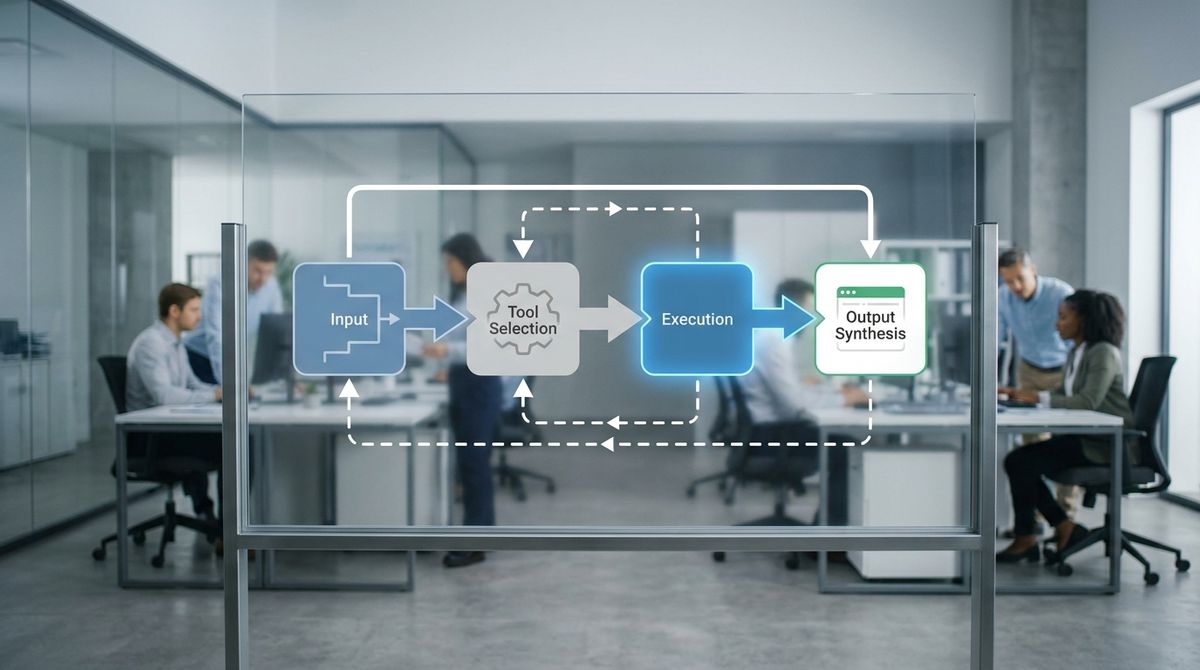
With MCP, this workflow is transformed. The customer support agent interacts with a unified LLM interface. Behind the scenes, the LLM agent is equipped with MCP-defined tool specifications for querying the Salesforce API (e.g., 'getCustomerHistory(customerId)'), searching the Confluence API (e.g., 'searchKnowledgeBase(query, category)'), and accessing the external support portal. When a customer inquiry arrives, the LLM intelligently selects and invokes these tools based on the defined schemas. For example, if a customer asks about a past order, the LLM calls 'getCustomerHistory' with the customer ID, retrieves the structured data, and then synthesizes a coherent response, potentially cross-referencing product details from a Confluence search.
The benefits are immediate and measurable. Resolution times for customer inquiries can decrease by 20-30%, translating to significant operational savings and improved customer satisfaction. The accuracy of information provided to customers increases because the LLM is reliably querying authoritative systems rather than relying on its internal, potentially outdated, training data. Furthermore, new agents can be onboarded faster, as they interact with a single, intelligent interface that abstracts away the complexity of multiple backend systems. This practical application demonstrates how MCP moves beyond theoretical benefits to deliver concrete, quantifiable improvements in real-world enterprise operations.
Architectural Trade-offs and Implementation Considerations
While MCP offers significant advantages, its implementation is not without trade-offs. The most notable is the initial overhead required to define comprehensive and accurate MCP schemas for all existing and new tools. This upfront design work demands a thorough understanding of each tool's capabilities, input validation rules, and potential error states. For organizations with a vast, undocumented legacy of internal APIs, this schema definition phase can be substantial. However, this investment should be viewed as analogous to defining OpenAPI specifications for microservices; it pays dividends in long-term maintainability, developer velocity, and system robustness.
Another consideration is the potential for minor performance implications. Introducing an additional layer of abstraction, where the LLM parses MCP schemas and an intermediary agent orchestrates tool calls, can introduce a slight increase in latency compared to highly optimized, direct API integrations. For applications demanding sub-millisecond response times, this overhead might require careful optimization of the MCP processing pipeline or selective bypass for critical, low-latency paths. However, for most agentic workflows where human interaction or complex reasoning dominates, the added latency is typically negligible compared to the gains in reliability and maintainability.
Finally, MCP simplifies the *interaction* between LLMs and tools, but it does not absolve the underlying tools of their inherent complexity. A tool, even with a perfectly defined MCP schema, still requires robust backend services to function. This includes proper authentication, authorization, rate limiting, and comprehensive error handling within the tool's own implementation. MCP ensures the LLM knows *how* to call the tool and *what* to expect, but the tool itself must be resilient. Organizations must continue to invest in well-engineered services that underpin their MCP-compliant tools, recognizing that the protocol enhances communication, not fundamental service quality.
Implementing MCP: A Practical Checklist
Adopting the Model Context Protocol requires a structured approach to ensure a smooth transition and maximize benefits. Begin by identifying a specific, high-value workflow within your organization that currently struggles with brittle LLM tool integrations or manual context stitching. This focused scope allows for a manageable pilot project and clear measurement of impact. Success in this initial phase will build momentum for broader adoption.
The following steps outline a practical path to implementing MCP, ensuring your AI agents can leverage external tools effectively and reliably:
Successfully implementing MCP requires a commitment to detail and iterative refinement. Start small, learn from your initial deployments, and gradually expand the scope. This methodical approach minimizes disruption while building a robust foundation for your enterprise AI strategy.
- Define tool capabilities: Explicitly list each tool's functions, their intended purpose, and the specific business value they provide.
- Create MCP schemas: Formalize tool definitions using a structured format (e.g., OpenAPI-like JSON schemas) for inputs, outputs, and error types.
- Develop tool wrappers: Implement lightweight code that translates generic MCP calls into the specific API calls required by your actual backend services.
- Integrate with LLM framework: Configure your agent framework (e.g., LangChain, LlamaIndex, or custom orchestrators) to consume MCP schemas for tool discovery and invocation.
- Implement robust error handling: Design for graceful degradation, providing clear error messages to the LLM and fallback mechanisms for tool failures.
- Monitor and iterate: Continuously track tool usage patterns, success rates, context window efficiency, and agent performance to identify areas for improvement.
Beyond Tool Use: Broader Implications for AI Systems
The impact of the Model Context Protocol extends far beyond merely improving single-agent tool use. MCP lays a crucial foundation for the development of sophisticated multi-agent systems and complex workflow orchestration. By providing a common language for tool capabilities, MCP enables agents to not only use tools but also to understand and delegate tasks to other agents that possess specific tool access. This creates a highly modular and collaborative AI ecosystem where specialized agents can cooperate on intricate problems, each contributing their unique capabilities in a standardized manner.
Furthermore, MCP facilitates the potential for dynamic tool discovery and self-healing AI systems. With standardized schemas, an LLM agent could theoretically explore a registry of available tools, dynamically identify new functionalities relevant to its current task, and integrate them on the fly, without explicit pre-configuration. In the event of a tool failure or deprecation, the agent could potentially identify alternative tools that offer similar capabilities by comparing their MCP schemas, thereby self-healing or adapting its execution plan without human intervention. This vision represents a significant leap towards more autonomous and resilient AI applications.
Ultimately, MCP contributes to the evolution of a more robust, auditable, and transparent AI ecosystem. The explicit nature of tool definitions and interactions makes it easier to trace an agent's reasoning path, understand why a particular tool was chosen, and debug issues. This transparency is vital for regulatory compliance, risk management, and building user trust in AI systems. By formalizing the contract between LLMs and the external world, MCP is not just improving integration; it is shaping the fundamental architecture of future intelligent applications, making them more reliable, adaptable, and understandable.
Next Steps: Preparing Your AI Stack for MCP
The shift towards standardized LLM tool integration through protocols like MCP is inevitable for enterprises seeking scalable, reliable AI. The immediate next step for engineering leaders and product managers is to initiate an internal audit of existing AI initiatives. Identify areas where LLM agents are currently integrated with external tools using ad-hoc methods, particularly those exhibiting brittleness, high maintenance costs, or inconsistent performance. These represent prime candidates for an MCP pilot program.
Following the audit, conduct a comprehensive inventory of your organization's most critical tools and APIs. Assess their current documentation and readiness for formal schema definition. Prioritize tools that are frequently used by LLM agents or those that are central to high-value business processes. Begin to draft preliminary MCP schemas for these prioritized tools, even if it's a lightweight internal standard to start. This exercise will highlight gaps in existing API contracts and prepare your teams for a more formal protocol adoption.
Finally, select a single, well-defined workflow to pilot an MCP-driven agent. This could be a specific customer service task, a data retrieval process, or an internal knowledge management query. Implement the agent using an MCP-compliant framework and rigorously measure its impact on key metrics such as accuracy, latency, and developer velocity. Leverage this tangible success to build a business case for broader adoption, demonstrating how MCP transforms brittle integrations into a robust, scalable foundation for your enterprise AI strategy.
Written by