Meet GitAgent: The Unified Platform Solving AI Agent Fragmentation Across LangChain, AutoGen, and Claude Code
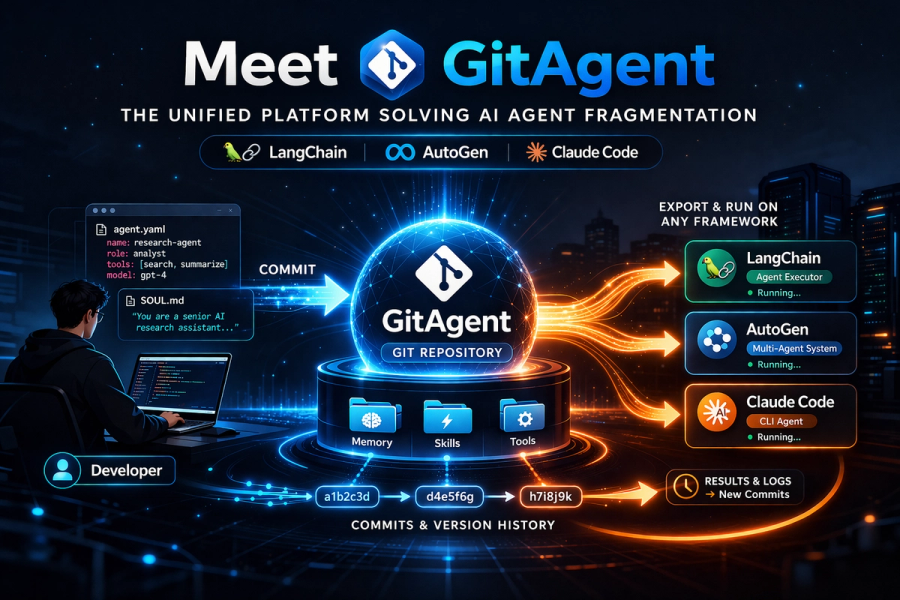
Introduction: The Hidden Problem in Agentic AI
AI agents are everywhere in 2026.
From autonomous coding assistants to multi-agent research systems, frameworks like LangChain, AutoGen, and Claude Code are powering the next wave of intelligent applications.
But there’s a serious problem nobody talks about enough:
Fragmentation.
Each framework defines agents differently.
Each ecosystem has its own structure, memory format, and execution model.
The result?
- Developers rebuild the same agent multiple times
- Teams get locked into specific frameworks
- Scaling across tools becomes painful
- Collaboration and governance break down
As one developer insightfully put it:
“Define an agent once? Not possible today.”
This is exactly the problem GitAgent is designed to solve.
What is GitAgent?
GitAgent is a Git-native, framework-agnostic open standard for defining, versioning, and running AI agents.
At its core, GitAgent introduces a simple but powerful idea:
Your repository is your AI agent.
Instead of defining agents inside frameworks, GitAgent defines them as:
- Files
- Folders
- Configs
- Memory logs
- Knowledge bases
All stored and versioned in Git.
Core Concept
my-agent/
| ├── agent.yaml # configuration |
| ├── SOUL.md # identity & behavior |
| ├── memory/ # evolving knowledge |
| ├── skills/ # capabilities |
| ├── tools/ # integrations |
This structure becomes:
- Portable
- Reproducible
- Framework-independent
GitAgent essentially acts as:
“Docker for AI agents” — but for behavior, not containers
Why Fragmentation Exists in AI Agents
To understand GitAgent’s importance, we need to look at how current frameworks evolved.
1. Framework-Centric Design
Frameworks like LangChain provide modular tools for building agents with memory, tools, and workflows .
Meanwhile, AutoGen focuses on multi-agent conversations and coordination .
And Claude Code uses markdown-based configurations like CLAUDE.md to define behavior .
Each framework solves the same problem differently.
2. Convergent Evolution, Divergent Standards
Interestingly, all frameworks converged on a similar idea:
Agents = files + instructions
But they implemented it differently:
CLAUDE.md.cursorrulesagent.yamlcrew.yamlAGENTS.md
Same idea. Different formats.
No shared standard = total fragmentation
3. Developer Pain
This leads to real-world issues:
- Rewriting agents across frameworks
- No portability of “agent intelligence”
- Difficult debugging and versioning
- No audit trail for decisions
GitAgent’s Breakthrough: A Universal Agent Standard
GitAgent introduces a new abstraction layer:
Separate agent definition from agent execution
Key Principles
1. Git as the Control Plane
GitAgent uses Git not just for code—but for:
- Versioning agent behavior
- Tracking memory updates
- Reviewing decisions
- Enabling collaboration
Every agent change becomes a commit.
2. One Agent, Any Framework
Define once → Run anywhere:
- LangChain
- AutoGen
- Claude Code
- OpenAI tools
- CrewAI
No rewriting required
3. Stateless Compute, Stateful Git
GitAgent flips traditional architecture:
- Compute = temporary
- Git = permanent state
Every action (memory, decisions, outputs) is recorded as commits
4. Composability
Agents can:
- Extend other agents
- Delegate tasks
- Share skills
- Build hierarchies
True multi-agent ecosystems
GitAgent Architecture Explained
Here’s how GitAgent works under the hood:
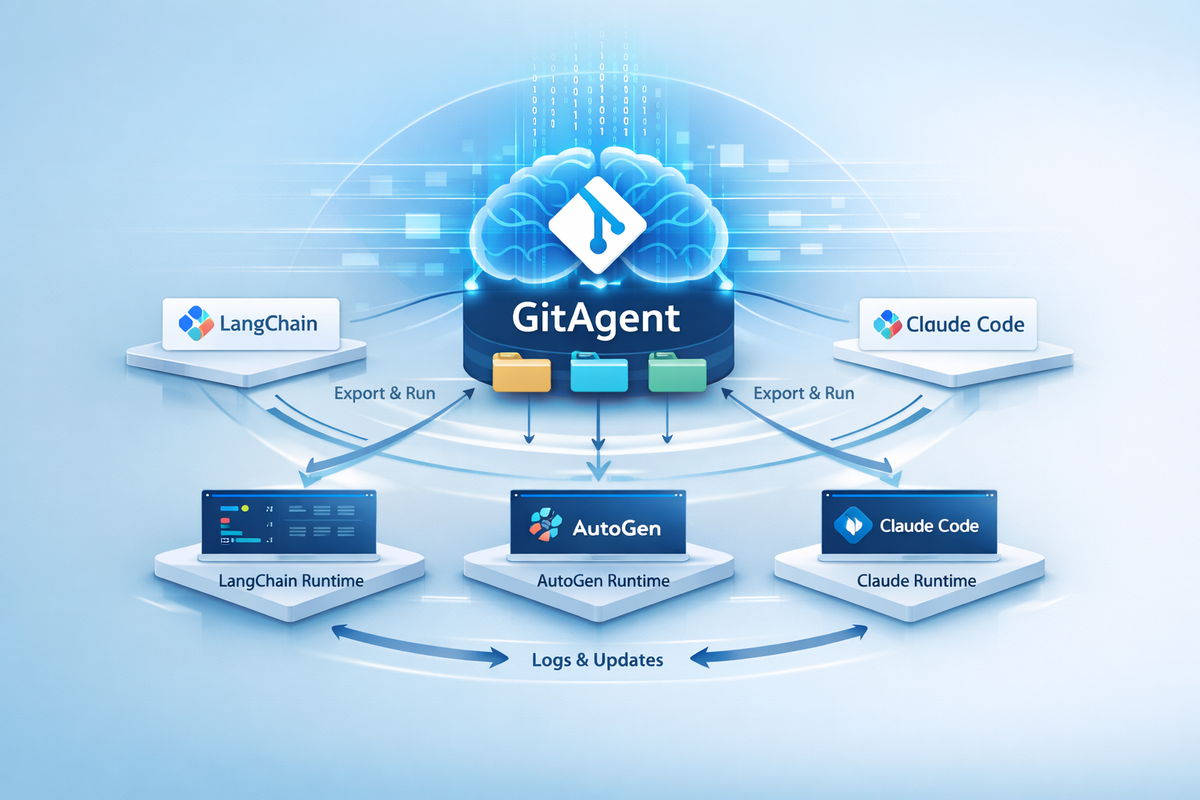
Architecture Flow
- Define Agent (Git Layer)
- agent.yaml
- memory/
- skills/
- Version & Collaborate
- commits
- branches
- pull requests
- Export to Runtime
- adapters convert to framework-specific format
- Execute Agent
- runs in chosen framework
- Capture State
- logs + memory → committed back to Git
Developer Workflow with GitAgent
Let’s compare traditional vs GitAgent workflow.
Traditional Workflow
- Build agent in LangChain
- Rewrite for AutoGen
- Adapt for Claude Code
- Lose consistency
- Debug separately
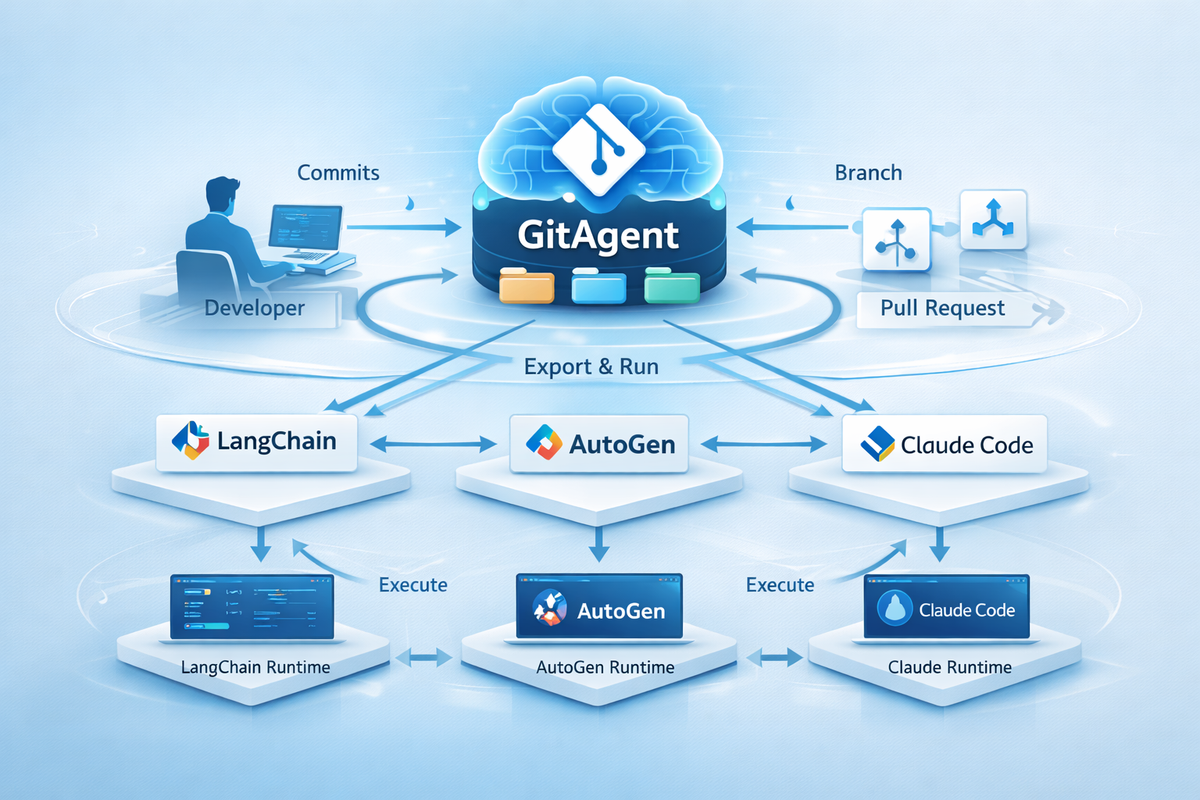
GitAgent Workflow
- Define agent once in Git
- Push to repo
- Run anywhere:
gitagent run -a langchain
gitagent run -a autogen
gitagent run -a claude
Real-World Use Cases
1. Enterprise AI Governance
Large organizations struggle with:
- Compliance
- Auditability
- Standardization
GitAgent enables:
- Full audit trails
- Reviewable AI decisions
- Controlled deployments
Perfect for regulated industries
2. Multi-Agent Systems at Scale
Modern AI apps use multiple agents:
- Planner
- Executor
- Researcher
- Critic
GitAgent allows:
- Modular agent composition
- Reusable agent components
- Cross-team collaboration
3. AI Product Development Teams
Teams can:
- Share agents via repositories
- Fork and customize agents
- Maintain version history
Similar to open-source software workflows
4. AI Startups & Experimentation
Startups benefit from:
- Fast iteration
- Framework flexibility
- Reduced lock-in
Build once, test everywhere
5. Autonomous Coding Systems
With tools like Claude Code:
- Agents write code
- Update memory
- Improve themselves
GitAgent ensures:
- Safe evolution
- Human-in-the-loop review
- Traceable changes
GitAgent vs Existing Frameworks
| Feature | LangChain | AutoGen | Claude Code | GitAgent |
| Agent Definition | Code-based | Conversational | Markdown-based | Git-based standard |
| Portability | ❌ | ❌ | ❌ | ✅ |
| Version Control | Limited | Limited | Partial | Full Git |
| Multi-Framework Support | ❌ | ❌ | ❌ | ✅ |
| Collaboration | Medium | Medium | Low | High |
| Auditability | Low | Medium | Medium | High |
Key Insight
- Frameworks build agents
- GitAgent connects them all
GitAgent vs Docker (Why the Analogy Works)
| Docker | GitAgent |
| Standardizes app deployment | Standardizes agent definition |
| Container image | Agent repository |
| Runs anywhere | Runs on any framework |
| DevOps revolution | AgentOps revolution |
GitAgent could do for AI agents what Docker did for cloud computing.
Challenges & Limitations
GitAgent is powerful—but not perfect.
1. Adapter Complexity
Exporting to multiple frameworks requires:
- Reliable translation layers
- Standard compatibility
2. Ecosystem Adoption
For success, GitAgent needs:
- Community support
- Framework integrations
- Industry buy-in
3. Performance Overhead
Git-based state tracking may introduce:
- Latency
- Storage overhead
4. Standardization Wars
Competing standards may emerge.
The Future of Agent Development
We’re moving toward:
Agent-Native Infrastructure
Where:
- Agents are first-class citizens
- Git is the control plane
- Frameworks are execution engines
AI as Versioned Intelligence
Instead of:
❌ Static models
✅ Evolving, versioned agents
Cross-Framework Interoperability
A future where:
- Agents move freely across ecosystems
- Innovation happens faster
- Lock-in disappears
Final Thoughts
GitAgent represents a fundamental shift in how we think about AI agents.
It doesn’t replace frameworks like LangChain or AutoGen.
It sits above them.
It turns:
- Agents → assets
- Behavior → versioned logic
- AI → collaborative software
Conclusion
The AI agent ecosystem is at the same stage cloud computing was before Docker:
- Powerful
- Fragmented
- Hard to scale
GitAgent introduces:
A universal standard for agent development
If adopted widely, it could:
- Eliminate framework lock-in
- Enable true multi-agent ecosystems
- Bring software engineering discipline to AI
Written by