Long Context Windows vs. RAG: Strategic Choices for LLM Applications
The Context Conundrum: When More Isn't Always Better
The rapid expansion of Large Language Model (LLM) context windows has introduced a significant architectural question for engineering leaders: should we simply feed all relevant information directly into the prompt, or is a more sophisticated Retrieval Augmented Generation (RAG) approach still necessary? This dilemma is critical for anyone building production-grade AI applications, as the choice impacts performance, cost, accuracy, and scalability. While the allure of 'just stuffing everything in' is strong due to its apparent simplicity, a deeper understanding of the underlying trade-offs reveals a more nuanced reality.
For technical founders and product managers, navigating this decision requires a clear grasp of both methodologies. Relying solely on a large context window can lead to hidden costs and performance bottlenecks, even as it simplifies initial prototyping. Conversely, implementing a robust RAG system introduces its own complexities but often yields more reliable, auditable, and cost-effective outcomes for enterprise use cases. This discussion aims to dissect these approaches, providing a framework for making informed architectural decisions in the evolving landscape of LLM-powered solutions.
Understanding Long Context Windows: Benefits and Limitations
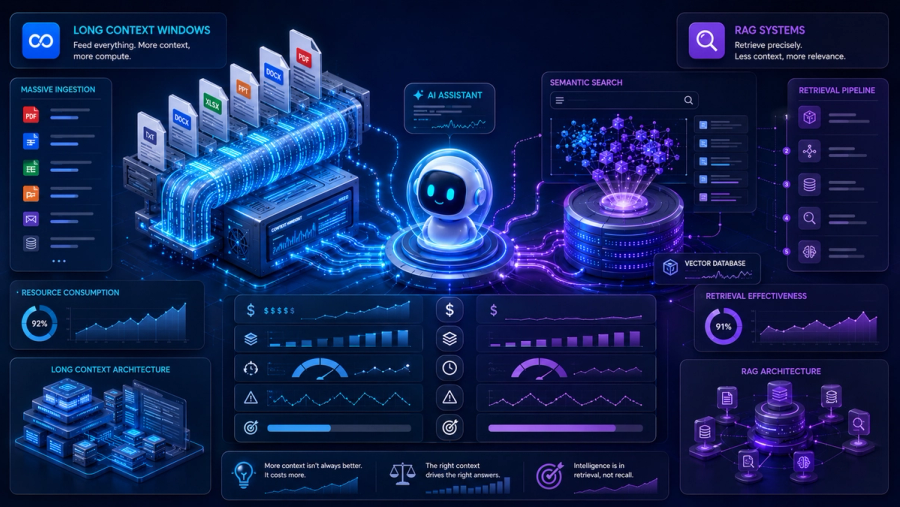
Long context windows enable LLMs to process significantly larger inputs, allowing developers to include extensive documentation, chat histories, or data points directly within a single prompt. This capability simplifies prompt engineering by reducing the need for complex retrieval mechanisms in certain scenarios. For tasks requiring the model to synthesize information from a contained, moderately sized document or conversation log, a large context window can be highly effective, offering a direct and immediate way to provide the LLM with all necessary information to generate a response. It streamlines the development process for specific applications where the entire dataset fits within the token limit.
However, the benefits come with inherent limitations. Processing larger contexts incurs higher computational costs, leading to increased API expenses and potentially slower inference times. Furthermore, LLMs can exhibit a 'lost in the middle' phenomenon, where information positioned at the beginning or end of a very long context is recalled more effectively than information buried in the middle. This can lead to decreased accuracy and reliability, especially with critical facts. Token limits, while expanding, are still finite, meaning truly vast knowledge bases cannot be fully accommodated, and the risk of hallucination, while mitigated by providing more context, is not entirely eliminated if the model struggles to pinpoint relevant details within the noise.
RAG: A Structured Approach to Information Retrieval
Retrieval Augmented Generation (RAG) operates on a different principle: instead of feeding all data to the LLM, it first retrieves only the most relevant pieces of information from a knowledge base and then passes those specific snippets to the LLM alongside the user's query. This two-stage process typically involves an indexing component, where documents are chunked and embedded into a vector database, and a retrieval component that uses semantic search to find the most pertinent chunks based on the query. The LLM then synthesizes its response using this targeted, grounded information.
The primary advantages of RAG include enhanced accuracy and reduced hallucination by grounding responses in verifiable external data. It offers a scalable solution for vast knowledge bases, as only a small fraction of the data is ever sent to the LLM. RAG also provides better control over the information source, making responses more auditable and easier to update as the underlying data changes. This approach is particularly valuable for enterprise applications where data freshness, factual accuracy, and the ability to cite sources are paramount, enabling LLMs to operate effectively on dynamic and extensive proprietary information without retraining.
Key Trade-offs and Decision Factors
Choosing between long context windows and RAG involves evaluating several critical trade-offs. Cost is a major factor; while large context windows simplify development, they often lead to higher per-token API costs, especially with increased usage. RAG, by sending fewer tokens to the LLM, can be significantly more cost-effective at scale, despite the initial investment in building and maintaining the retrieval infrastructure. Performance is another consideration; RAG introduces retrieval latency, but if the context window is excessively large, the LLM's processing time can also become substantial, potentially nullifying the advantage of direct input.
Accuracy and reliability also diverge. While a long context window can provide all information, the LLM's ability to precisely extract and utilize specific facts can degrade with length due to the 'lost in the middle' effect. RAG, by pre-filtering for relevance, often delivers more precise and factually grounded responses, reducing the risk of the model overlooking crucial details. Data freshness and dynamism heavily favor RAG, as updating a vector database is far more agile than retraining or fine-tuning an LLM. Finally, development complexity shifts: long context is simpler for initial proofs-of-concept, but RAG offers greater control, explainability, and scalability for production systems dealing with evolving, extensive data.
Strategic Implementation: When to Choose Which
The optimal choice between long context and RAG is not absolute; it depends heavily on the specific application requirements, data characteristics, and operational constraints. For simpler, contained tasks where the total information volume is manageable and static, leveraging a long context window might be the more straightforward and efficient path. However, for complex enterprise systems, RAG often presents a more robust and scalable architecture.
Thoughtful system design requires a clear understanding of these distinctions to avoid common pitfalls. Misapplying a long context window to a vast, dynamic knowledge base can lead to spiraling costs, unreliable outputs, and a frustrating user experience. Conversely, over-engineering RAG for a trivial problem introduces unnecessary complexity. The decision should align with the long-term strategic goals for the AI application, considering factors like data growth, required accuracy, and budget constraints.
- Choose Long Context Windows when: The total relevant information fits comfortably within the token limit, the data is relatively static, the task requires broad synthesis rather than precise fact retrieval, and rapid prototyping is a priority.
- Choose RAG when: The knowledge base is extensive and dynamic, factual accuracy and auditability are critical, cost efficiency at scale is a primary concern, information needs to be updated frequently, or the application requires grounding in proprietary, sensitive, or external data sources.
- Consider a hybrid approach when: A core set of essential, static context is always needed (long context), but supplementary, dynamic details are retrieved on demand (RAG).
Building Robust LLM Applications
Ultimately, the effectiveness of an LLM application hinges on how intelligently it accesses and processes information. The temptation to simply 'stuff everything into the prompt' with ever-growing context windows is understandable, given the immediate gratification it offers during development. However, for mid-market and enterprise companies building mission-critical AI solutions, this approach often falls short of meeting production demands for cost-efficiency, accuracy, and scalability.
Engineering leaders, product managers, and technical founders must approach LLM system design with a strategic mindset, recognizing that RAG, while adding architectural complexity, delivers superior control, grounding, and performance for most real-world enterprise scenarios. By carefully evaluating the trade-offs and choosing the right information access strategy, organizations can build robust, reliable, and future-proof AI applications that truly deliver business value.
Written by