GitOps in 2026: Making Your Git Repo the Single Source of Truth for Infrastructure
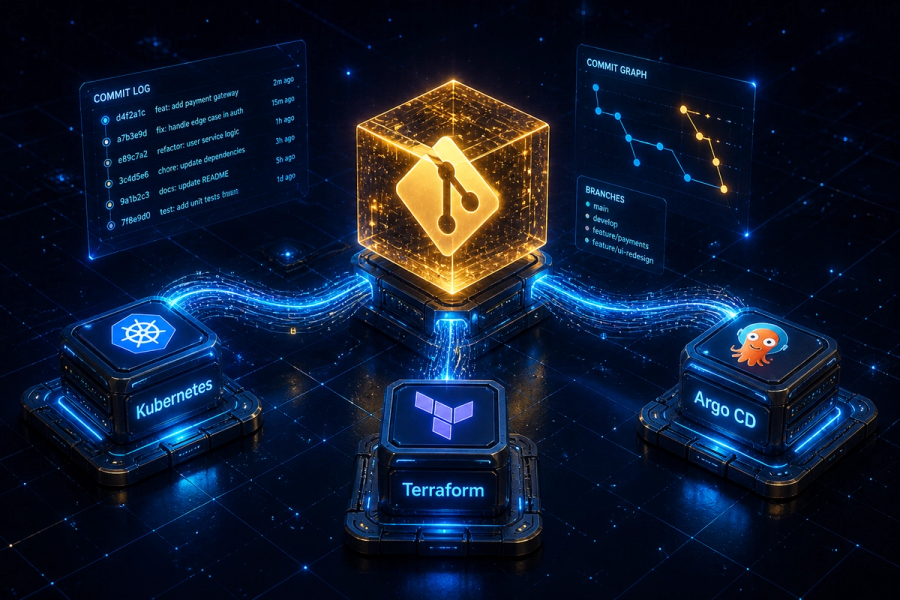
If you've managed cloud infrastructure for more than a year, you've probably lived this nightmare — a config change made directly in the AWS console, no record of who did it, a broken deployment at 2 AM, and a team scrambling to figure out what changed. GitOps was built to end that cycle.
The idea is simple: your Git repository is the single source of truth for your entire infrastructure. Every server, every network rule, every deployment config lives in Git. If it isn't in Git, it doesn't exist. If it isn't reviewed and merged, it doesn't deploy.
What GitOps Actually Means
GitOps isn't just "using Git for infrastructure." It's declarative infrastructure managed through Git workflows, with automated agents that continuously sync your live environment to match whatever your repo declares.
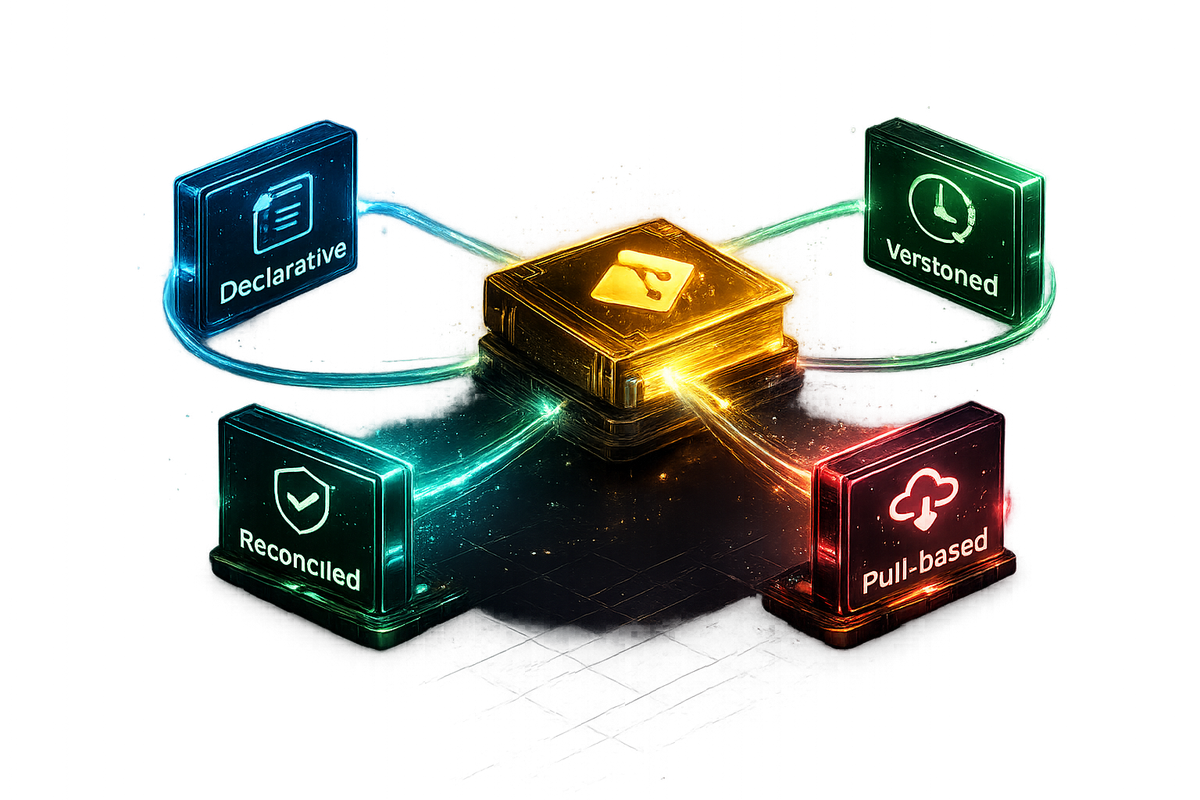
The four core principles:
| Principle | What It Means |
| Declarative | Describe what you want, not how to get there (Terraform, Helm, K8s manifests) |
| Versioned & Immutable | Every change is a commit. Rollbacks are a Git revert. |
| Pull-Based | Agents inside your cluster pull from Git — nothing is pushed from outside |
| Continuously Reconciled | The system keeps checking and correcting live state to match Git — always |
The last point is what separates GitOps from traditional CI/CD. A regular pipeline pushes changes on trigger. A GitOps controller runs in a loop — always watching, always correcting drift.
The GitOps Tooling Landscape in 2026
Argo CD and Flux — The Kubernetes Core
Argo CD is the most widely adopted GitOps controller. It has a rich UI, real-time sync status, and clean multi-cluster support. Best for teams that want visibility and a polished operator experience.
Flux v2 is lighter and more composable. It's particularly strong for platform teams managing many clusters, and it natively supports OCI artifacts and SOPS-encrypted secrets.
Both now support OCI artifacts — storing Kubernetes manifests and Helm charts directly in your container registry. GitOps controllers pull from there, not just from Git.
Terraform & OpenTofu — Infrastructure Below Kubernetes
For managing VPCs, databases, IAM, and DNS — Terraform remains dominant, with OpenTofu (the open-source fork) gaining serious enterprise traction. Both plug into GitOps via Atlantis or Spacelift: a developer opens a PR → Atlantis posts the plan as a comment → reviewer approves → merge triggers apply. Every change tracked, every change auditable.
Crossplane — Cloud Resources, Kubernetes-Native
Crossplane is now mainstream. It lets you manage AWS RDS, S3, GCP Cloud SQL, and more using Kubernetes custom resources — meaning your entire infrastructure, cloud-level and cluster-level, lives in one GitOps-managed control plane. One system. One workflow. One source of truth.
How to Structure Your Git Repo
Two approaches work at scale:
Monorepo — app code, manifests, Terraform, Helm values all in one repo. Great for small teams. Becomes harder to manage as teams grow without strict CODEOWNERS rules.
Polyrepo (recommended at scale) — separate repos for app code and infrastructure config. Your CI pipeline builds the image, then opens an automated PR in the config repo to update the image tag. A human approves, the controller deploys. Clean audit trail, zero noise from dev commits.
A clean config repo structure looks like this:
infrastructure/
├── clusters/
│ ├── production/
│ │ ├── apps/
│ │ └── infrastructure/
│ └── staging/
│ ├── apps/
│ └── infrastructure/
├── base/
│ └── common-configs/
└── terraform/
├── networking/
├── databases/
└── iam/
Handling Secrets (The Most Common Stumbling Block)
You cannot commit raw secrets to Git. But your GitOps controller needs to apply manifests that reference secrets. Here's how teams solve it:
Sealed Secrets — encrypts your K8s secrets with a public key only your cluster can decrypt. You commit the encrypted resource safely. Simple and cluster-scoped.
External Secrets Operator (ESO) — the enterprise standard. Connects to AWS Secrets Manager, HashiCorp Vault, GCP Secret Manager, or Azure Key Vault and syncs secrets into your cluster automatically. Your repo only stores a pointer — the actual secret never touches Git. Supports automatic rotation.
SOPS — encrypts secret files before you commit them using age or PGP. Flux natively supports SOPS, making this a smooth fit for Flux users who want to keep everything repo-native.
Drift Detection — The GitOps Superpower
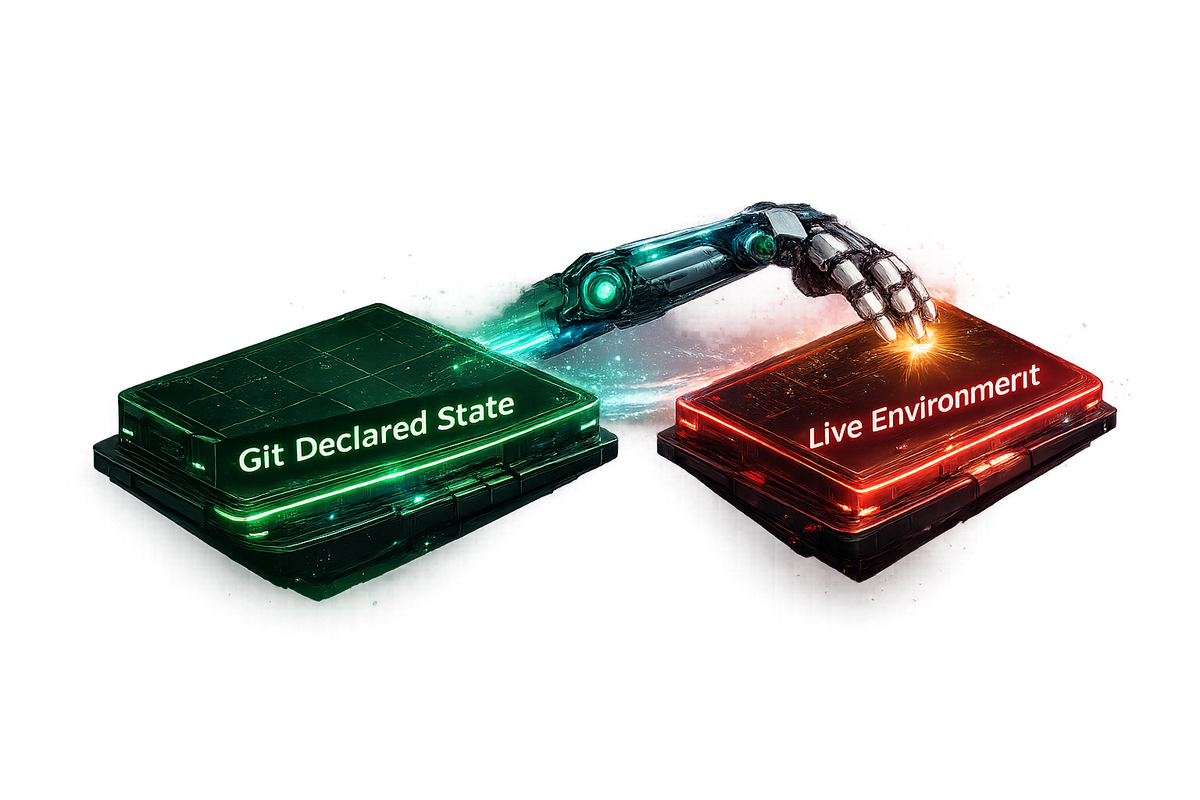
When someone makes a manual change directly in production — through the console, via kubectl, through a Terraform one-liner — a GitOps controller detects that the live state no longer matches what's declared in Git, and corrects it.
This means two things in practice:
- Your infrastructure is always in a known, auditable state
- Config drift — the slow erosion of your infra's integrity through ad-hoc changes — becomes structurally impossible
Most teams configure their controller to alert on drift first, rather than immediately overwrite. This lets your ops team decide whether the manual change was intentional (needs a PR) or accidental (needs a revert). Argo CD and Flux both integrate with Slack and PagerDuty for real-time drift alerts.
Multi-Cluster and Environment Promotion
Most enterprise Kubernetes setups in 2026 span multiple clusters across clouds and regions. GitOps handles this cleanly.
Argo CD ApplicationSets let you deploy one application template across dozens of clusters simultaneously. One config change propagates everywhere through the ApplicationSet controller.
Flux's multi-tenancy model scopes each team to their own namespace and GitOps config, with the platform team managing cluster-level infrastructure and enforcing RBAC boundaries.
For environment promotion (staging → production), the cleanest pattern is automated image tag PRs: CI builds the image, updates staging config, staging tests pass, CI opens a PR against the production config with the new tag. A human approves. Controller deploys. No shell scripts. Full traceability.
Policy Enforcement — Your Last Line of Defense
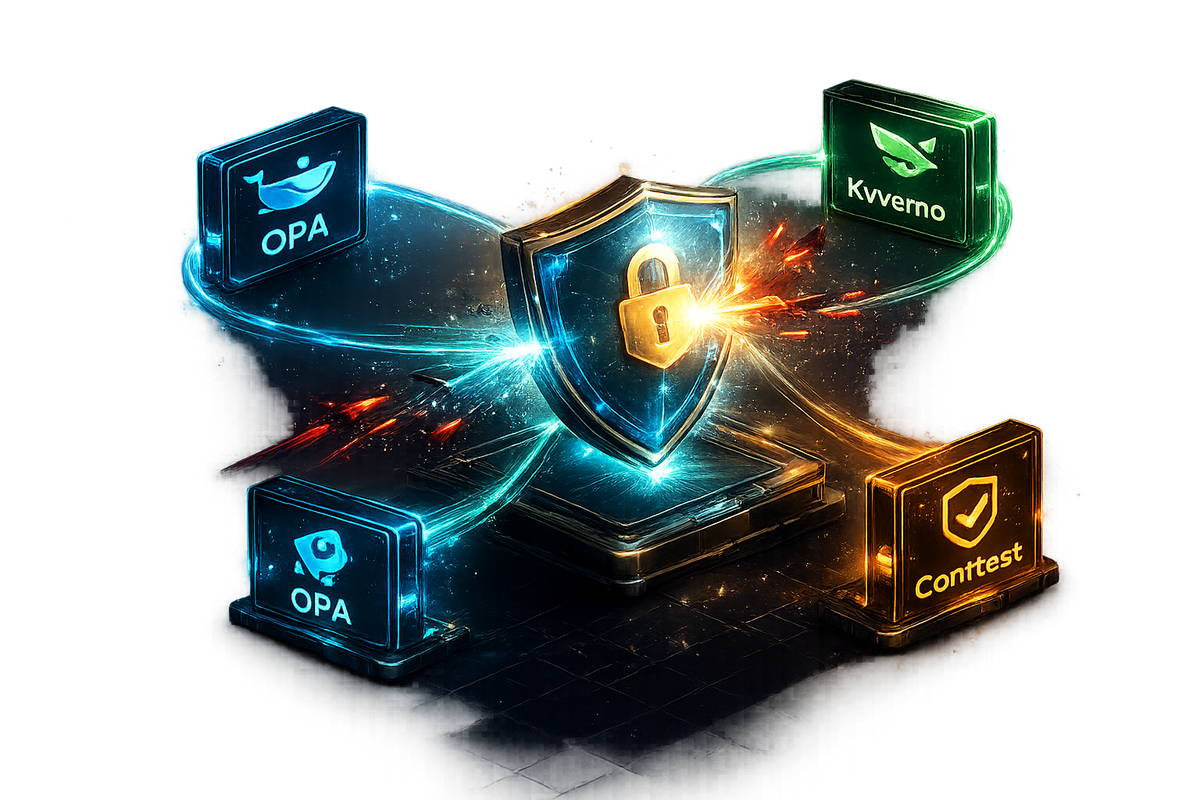
A Git repo as your source of truth only works if what goes in meets your standards.
OPA with Gatekeeper enforces Kubernetes admission policies — nothing violating your rules gets into the cluster, regardless of how it arrived.
Conftest runs OPA policies against your Terraform and K8s manifests in CI, before they reach the cluster. Catches violations at PR time, not deploy time.
Kyverno is a Kubernetes-native alternative to Gatekeeper with a simpler YAML-based policy language — easier to maintain for most platform teams.
Why It Matters: The Business Case
| Benefit | What It Looks Like in Practice |
| Faster incident recovery | Rollback = Git revert + merge. No manual reconstruction. |
| Stronger compliance | Every change has an author, timestamp, reviewer, and merge record — exactly what SOC 2, ISO 27001, and PCI DSS auditors ask for |
| Lower cognitive load | New engineers read the repo to understand the system. No tribal knowledge required. |
| Fewer incidents | No drift, consistent state, policy enforcement at every layer |
How to Get Started
- Start small. Pick one non-critical app, one cluster. Set up Argo CD or Flux. Get comfortable with the pull-based model before scaling.
- Decide your repo structure upfront. Monorepo or polyrepo — pick one before you build. Reorganizing later is painful.
- Solve secrets on day one. Don't defer it. ESO if you have a secret manager, Sealed Secrets if you want simplicity.
- Automate image tag PRs. Wire your CI pipeline to open config repo PRs automatically. This closes the app-to-infra loop.
- Alert on drift before you auto-remediate it. Build operational confidence first, then let the system self-correct.
- Expand to multi-cluster and add policy enforcement once your single-cluster workflow is stable and trusted.
Final Thoughts
GitOps in 2026 is not a niche DevOps philosophy — it's the operational model that serious engineering teams have converged on. The tooling is mature. The patterns are proven. The business case is clear.
The real shift is cultural: your infrastructure is reviewed, not assumed. "What's running in production and why?" is always answered by the repository, not by someone's memory.
If your team is still managing infrastructure through console clicks and manual scripts, 2026 is the year to change that. Your Git repo is waiting to do a lot more work.
Written by