Apache Kafka + AI Agents: Building Real-Time Event-Driven AI Pipelines
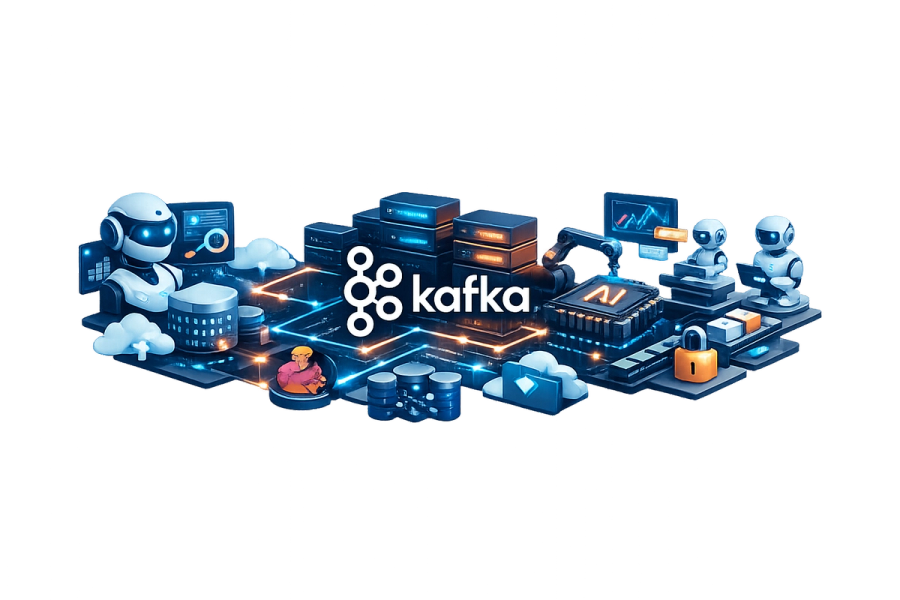
Artificial intelligence is no longer just about building smarter models. The real challenge today is giving those models the infrastructure they need to act autonomously, in real time, across complex distributed systems. This is where Apache Kafka enters the picture — not as a messaging tool, but as the backbone of intelligent, event-driven AI pipelines.
In this blog, we explore how Apache Kafka powers the next generation of AI agents, why event-driven architecture (EDA) is the natural foundation for agentic AI, and how you can start building real-time AI pipelines today.
What Are AI Agents?
AI agents are systems that go beyond answering a single prompt. They are autonomous, goal-driven systems that can perceive their environment, make decisions, plan multi-step actions, and execute tasks with minimal human supervision. Unlike traditional automation tools that follow rigid workflows, AI agents adapt to changing conditions in real time.
A single agent interaction might look like this:
- It receives a user request (event)
- It queries a knowledge base or LLM (event)
- It escalates to a human if confidence is low (event)
- It logs the interaction to a CRM or database (event)
These are not synchronous API calls chained together. They are a series of intentions and decisions spread across services, clouds, and runtimes. Managing this flow reliably requires an infrastructure built for events — and that is exactly what Apache Kafka provides.
Why Batch Processing Falls Short
Traditional AI pipelines often rely on batch processing — collecting data over a period of time and processing it in bulk. This approach introduces delays, data staleness, and rigid workflows that simply cannot keep up with autonomous AI agents operating in dynamic environments.
Consider a fraud detection agent in a bank. If it processes transactions every few hours, fraudulent activity can go undetected for hours. If it processes in real time, it can act in milliseconds. The difference is not just technical — it is a business imperative.
Agentic AI demands immediate access to consistent, trustworthy data. Batch architectures are fundamentally incompatible with that requirement.
Apache Kafka: The Event-Driven Backbone
Apache Kafka is an open-source distributed event-streaming platform built for high-throughput, low-latency, fault-tolerant data pipelines. At its core, it operates on a simple but powerful model:
- Producer: An application that writes events (messages) to Kafka topics
- Consumer: An application that reads from those topics
- Topic: A named, ordered log of messages
- Consumer Group: Multiple consumers sharing the load, enabling parallel processing
What makes Kafka ideal for AI agents is the combination of four key properties:
Horizontal Scalability — Kafka's distributed design supports the addition of new agents or consumers without bottlenecks. As your AI system grows, Kafka grows with it.
Low Latency — Real-time event processing enables agents to respond instantly to changes, ensuring fast and reliable workflows.
Loose Coupling — Agents communicate through Kafka topics rather than direct API dependencies, keeping them independent and modular.
Event Persistence — Durable message storage guarantees that no data is lost in transit. This is critical for high-reliability workflows, and it enables event replay for debugging or reprocessing.
AI Agents as Event Producers and Consumers
In a Kafka-powered AI architecture, every agent is both a producer and a consumer. An agent consumes events from a topic, processes them (often by calling an LLM or tool), and then produces new events to another topic. This creates a clean, observable pipeline where each stage is independent and traceable.
For example, in a real-time research assistant pipeline:
- A user creates a research request — this is saved to a database, which publishes an event to a Kafka topic called
research-requests - An agent consumes from that topic, fetches source URLs, extracts text, and generates vector embeddings
- The extracted text is published to a
full-text-from-sourcestopic - A second agent or stream processor (such as Apache Flink) consumes that topic and runs RAG (Retrieval-Augmented Generation) to generate a research brief
- The final output is delivered asynchronously to the user
This decoupled design means each stage can scale independently, fail without cascading, and be improved without rebuilding the entire pipeline.
Kafka + Apache Flink: Stateful Real-Time Intelligence
While Kafka handles reliable event streaming, Apache Flink adds stateful stream processing. Together, they form the complete foundation for production-grade agentic AI.
Flink allows agents to:
- Maintain state across multiple events (e.g., tracking a multi-step conversation or transaction history)
- Apply windowing operations (e.g., detecting patterns over the last 60 seconds)
- Call LLMs or embedding APIs directly within the stream processing logic
- Enable real-time RAG by pulling fresh context from vector databases during inference
This means your AI pipeline is not just processing events — it is reasoning over them, enriching them with context, and producing intelligent outputs in real time.
The Role of MCP and Agent-to-Agent (A2A) Protocols
Modern enterprise AI involves multiple agents working together. A customer service agent may need to collaborate with a billing agent, a logistics agent, and a fraud detection agent — all in real time, across different systems.
Two emerging standards are shaping how these agents communicate:
Model Context Protocol (MCP) — Provides the semantic structure for requests and responses between agents and tools, ensuring that context is preserved and exchanged consistently.
Google's Agent2Agent (A2A) Protocol — Defines how agents from different vendors and platforms can communicate with each other, enabling truly interoperable multi-agent systems.
Kafka acts as the event broker that connects these protocols. Instead of brittle point-to-point API integrations, agents communicate through durable, ordered event streams. Kafka ensures reliability and replayability; MCP and A2A provide the interoperability layer on top.
Handling Unstructured Data in Real-Time Pipelines
One of the more complex challenges in AI pipelines is processing unstructured data — PDFs, scanned documents, images — in real time. Traditional approaches rely on synchronous API chains or batch scripts that break under pressure.
A more resilient pattern uses the Claim Check approach: large binary files are stored in object storage (like Amazon S3 or Google Cloud Storage), while only the URI, metadata, and processing state are sent to Kafka. Topics are structured as state transitions:
raw_documents → refined_documents → curated_ai_assets
Each stage emits a new event when complete, allowing downstream agents to react immediately. Kafka's exactly-once transaction semantics prevent partial writes, and Dead Letter Queues (DLQs) isolate corrupt or unsupported files for later handling.
Real-World Use Case: AI in Regulated Financial Services
Alpian Bank, a Swiss digital wealth management firm, demonstrates how this architecture works in a highly regulated environment. Their platform is event-driven by design, with Apache Kafka as the central nervous system connecting all systems.
Each microservice publishes and consumes domain events asynchronously. AI agents operate with full autonomy, using these Kafka-based events to make decisions, trigger actions, or escalate issues when needed. Governance is embedded from the start — schema-driven development, field-level encryption, strict access controls, and explainability pipelines are all part of the architecture.
The result is a platform that delivers real-time, AI-powered banking experiences while remaining fully compliant with regulatory requirements.
Key Benefits of Event-Driven AI Pipelines
Building AI agents on top of Kafka-based event-driven architecture delivers several concrete advantages:
Resilience — If one agent or service fails, the event stream persists. Other consumers continue processing, and the failed component can replay events when it recovers.
Observability — Every action taken by every agent produces an event. This creates a full audit trail that makes debugging, compliance, and performance monitoring straightforward.
Scalability — New agents, new consumers, and new use cases can be added without modifying existing components. The system scales horizontally with demand.
Freshness — Agents always operate on the latest available data, eliminating the staleness that plagues batch-oriented systems.
Flexibility — The same event stream can be consumed by multiple agents simultaneously — for analytics, logging, transformation, and inference — without interference.
Getting Started: Architecture Patterns to Know
If you are building your first event-driven AI pipeline, here are the foundational patterns to understand:
Topic-per-agent-stage — Each processing stage publishes results to a dedicated topic. Downstream agents consume from that topic independently.
Dead Letter Queue (DLQ) — Route failed or unprocessable events to a DLQ topic for investigation and replay. This is essential for production reliability.
Exactly-Once Semantics — Use Kafka's transaction API to ensure that events are processed precisely once, avoiding duplicate actions in your AI pipeline.
Claim Check Pattern — For large payloads (documents, images), store the content in object storage and pass only the reference through Kafka.
Shift Left Architecture — Enrich, filter, and transform data as early as possible in the pipeline, reducing compute costs and improving data quality for downstream agents.
Conclusion
Apache Kafka is not just a messaging system — it is the infrastructure backbone that makes autonomous AI agents viable in production. By combining Kafka's reliable event streaming with stateful processing (via Apache Flink), semantic context protocols (MCP), and inter-agent communication standards (A2A), enterprises can build AI pipelines that are fast, scalable, observable, and trustworthy.
The future of AI is not a single powerful model. It is a coordinated network of intelligent agents, acting in real time, on a foundation of events. Kafka makes that foundation possible.
Whether you are building a fraud detection system, a real-time research assistant, or a multi-agent enterprise platform, the architecture is the same: events in, intelligence out.
Written by