Top AI Red Teaming Tools (2026): Secure Your ML Models from Modern Threats

Artificial Intelligence has rapidly evolved from experimental prototypes into mission-critical infrastructure powering applications across industries. From conversational agents to predictive analytics and autonomous systems, AI is deeply embedded in modern digital ecosystems.
However, as adoption accelerates, so do the risks. Unlike traditional software, AI systems behave unpredictably under adversarial conditions, making them vulnerable to new types of attacks. This is where AI red teaming becomes essential. In 2026, organizations are no longer asking whether they need AI security—they are asking how fast they can implement it.
What is AI Red Teaming?
AI Red Teaming is the practice of simulating real-world attacks on AI systems to identify vulnerabilities before malicious actors exploit them.
Unlike traditional penetration testing, AI red teaming focuses on behavioral failures, such as:
- Prompt injection attacks
- Data leakage from models
- Jailbreaks and safety bypasses
- Model manipulation and hallucinations
- Tool misuse in AI agents
Modern AI systems introduce new attack surfaces that conventional security tools cannot handle.
Key Insight: AI security is not just about code—it’s about how models behave under adversarial conditions.
Why AI Red Teaming is Critical in 2026

- The importance of AI red teaming has grown significantly due to the increasing number of real-world incidents involving AI systems. As AI becomes integrated into sensitive workflows—such as customer support, finance, healthcare, and decision-making—any vulnerability can have serious consequences.
- A compromised AI system can leak confidential data, generate harmful content, or even automate malicious actions at scale.
- In 2026, attackers are no longer limited to exploiting software bugs, they are actively targeting AI behavior. This shift has made AI red teaming a core part of cybersecurity strategy. Organizations like OpenAI and Google DeepMind have already emphasized the importance of rigorous safety testing before deploying models. Additionally, regulatory frameworks and compliance standards are beginning to require AI risk assessments, further increasing the need for robust red teaming practices.
What Makes a Good AI Red Teaming Tool?
Before choosing tools, understand what matters most:
1. Attack Surface Coverage
A strong tool should test:
- Input/output layer (prompt injection)
- Retrieval systems (RAG attacks)
- Agent behavior (tool misuse)
- Model vulnerabilities (data extraction)
- Infrastructure & pipelines
Most tools still only test prompts, missing deeper risks.
2. Automation & Scale
Modern tools must:
- Run continuous testing
- Simulate real attackers
- Adapt to system changes
3. CI/CD Integration
Security should be part of development—not an afterthought.
4. Realistic Attack Simulation
Top tools use:
- AI agents
- Multi-step attack chains
- Adversarial reasoning
Top AI Red Teaming Tools in 2026
The AI security landscape in 2026 includes a mix of enterprise platforms, open-source frameworks, and developer-focused tools. Each serves a different purpose, depending on the scale and complexity of the system being tested.
Repello AI ARTEMIS
- Repello AI ARTEMIS is widely regarded as one of the most comprehensive AI red teaming platforms available today. It is designed to test the full attack surface of AI systems, including models, APIs, and integrated workflows. What sets it apart is its ability to generate context-aware attack scenarios rather than relying on static test cases. This means the tool can simulate sophisticated, real-world attacks that evolve based on system behavior.
- The platform supports multimodal testing, making it suitable for applications that combine text, images, and voice inputs. It also aligns its findings with industry-standard frameworks, helping organizations map vulnerabilities to recognized security benchmarks. For enterprises looking for a scalable and automated solution, Repello provides a robust foundation for continuous AI security testing.
Key Features
- Tests full AI attack surface (not just prompts)
- Runs millions of evolving attack scenarios
- Supports multimodal AI (text, image, voice)
- Maps results to OWASP & MITRE frameworks
Mindgard
- Mindgard is a full-stack AI security platform built specifically for enterprise environments. It offers continuous red teaming capabilities, allowing organizations to monitor and test their AI systems in real time. This proactive approach ensures that vulnerabilities are detected early, reducing the risk of exploitation in production environments.
- One of Mindgard’s strengths lies in its ability to integrate seamlessly with existing AI workflows, including machine learning pipelines and API ecosystems. It also provides governance and compliance features, making it particularly valuable for organizations operating in regulated industries. By combining security testing with risk management, Mindgard helps enterprises build trustworthy AI systems.
Key Features
- Continuous AI red teaming
- Real-time attack simulation
- Works across models, APIs, and agents
- Strong compliance and governance support
Novee
- Novee represents a new generation of AI red teaming tools that use autonomous agents to simulate attacker behavior. Instead of relying on predefined scripts, Novee dynamically adapts its attack strategies based on system responses. This makes its testing approach more realistic and effective in identifying complex vulnerabilities.
- The platform is particularly strong in detecting lateral movement risks, where an attacker exploits one vulnerability to gain access to other parts of the system. It also extends beyond AI models to test cloud infrastructure and identity systems, providing a broader security perspective. For organizations seeking advanced, attacker-like simulation, Novee offers a powerful solution.
Key Features
- Adaptive attack strategies
- Continuous testing environment
- Identifies lateral movement risks
- Cloud + identity system testing
Penligent
- Penligent introduces a multi-agent approach to AI red teaming, where different AI agents collaborate to simulate a coordinated attack. One agent focuses on reconnaissance, another on exploitation, and another on reporting findings. This layered strategy mirrors how real-world attackers operate, making the testing process more comprehensive.
- The platform’s ability to perform multi-step reasoning allows it to uncover vulnerabilities that simpler tools might miss. At the same time, it ensures safe testing by preventing any damage to production systems. Penligent is particularly useful for advanced security teams that require deep and structured analysis of AI risks.
Key Features
- Recon + exploit + reporting agents
- Multi-step attack reasoning
- Safe exploitation (no system damage)
- Zero-setup deployment
OpenRT
- OpenRT is an open-source framework designed for researchers and developers who want flexibility and transparency in their testing processes. It supports a wide range of attack strategies and can be customized to test different types of AI models. Its modular architecture makes it easy to extend and adapt for specific use cases.
- One of OpenRT’s key contributions is its ability to highlight how even advanced models can fail under adversarial conditions. This makes it a valuable tool for understanding the limitations of AI systems and improving their robustness. For research-driven environments, OpenRT provides both depth and adaptability.
Key Features
- Supports 37+ attack strategies
- Works with multiple models
- High scalability for testing
- Modular architecture
PyRIT
- Developed as a Python-based toolkit, PyRIT focuses on identifying risks in AI systems through structured workflows. It is particularly effective for testing bias, toxicity, and other ethical concerns, in addition to security vulnerabilities. This makes it a well-rounded tool for developers who want to build responsible AI applications.
- PyRIT’s simplicity and integration capabilities make it a popular choice among teams working on LLM-based applications. It provides a practical entry point into AI red teaming without requiring complex setup or infrastructure.
Key Features
- Risk identification workflows
- Bias and toxicity testing
- Structured vulnerability analysis
Promptfoo
- Promptfoo is widely used to evaluate large language models at scale. Although it is not a full red teaming platform, it plays a critical role in testing model outputs and identifying inconsistencies. By running large sets of prompts and analyzing responses, Promptfoo helps teams detect weaknesses in model behavior.
- Its integration with CI/CD pipelines makes it ideal for continuous testing, ensuring models remain reliable as they evolve. For organizations focused on output validation and performance monitoring, Promptfoo is an essential tool.
Key Features
- Test prompts in bulk
- Evaluate responses automatically
- CI/CD integration
Garak
- Garak is a lightweight vulnerability scanner designed specifically for large language models. It focuses on detecting common issues such as prompt injection and safety bypasses. Although it does not offer the depth of enterprise platforms, its simplicity makes it useful for quick assessments and early-stage testing.
- Developers often use Garak as a first line of defense, identifying obvious vulnerabilities before moving on to more advanced tools. Its ease of use and fast setup make it a practical addition to any AI security toolkit.
Key Features
- Detects prompt injection
- Tests safety bypasses
- Easy integration
BlackIce
- BlackIce is a containerized toolkit inspired by traditional cybersecurity distributions like Kali Linux. It provides a pre-configured environment with multiple AI security tools integrated into a single platform. This approach simplifies the setup process and allows users to experiment with different testing techniques.
- By making AI red teaming more accessible, BlackIce helps bridge the gap between traditional security professionals and AI-focused testing. It is particularly useful for beginners and teams looking to standardize their testing environment.
Key Features
- Pre-configured tool environment
- Docker-based setup
- Multiple integrated tools
How to Choose the Right Tool
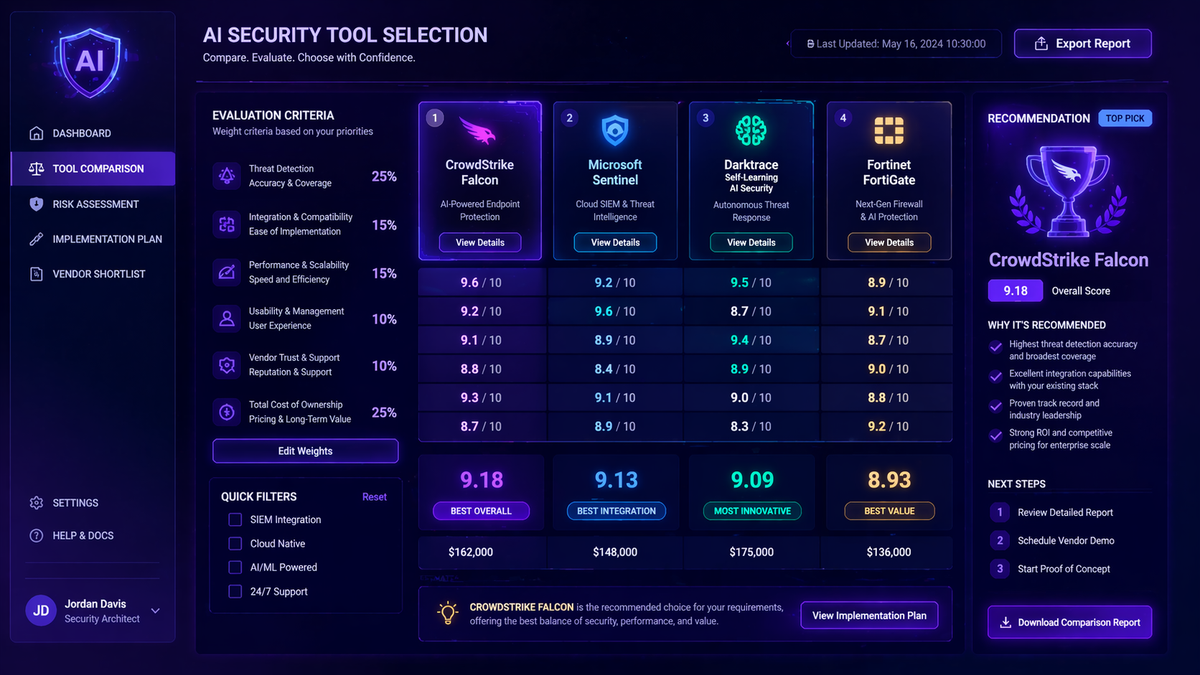
- Selecting the right AI red teaming tool depends on the size, complexity, and maturity of your AI systems. Startups and small teams often benefit from lightweight tools that are easy to integrate and require minimal resources. In contrast, large enterprises need comprehensive platforms that offer automation, scalability, and compliance features.
- It is also important to consider the level of expertise within your team. Some tools are designed for researchers and require advanced knowledge, while others are built for developers and prioritize ease of use. Ultimately, the best approach is to combine multiple tools to achieve comprehensive coverage across different layers of the AI system.
Future of AI Red Teaming
- The future of AI red teaming is moving toward automation and continuous testing. As AI systems become more complex, manual testing will no longer be sufficient. Autonomous attackers, powered by AI, will play a key role in identifying vulnerabilities in real time. At the same time, regulatory requirements will push organizations to adopt standardized security practices.
- AI security is also becoming a shared responsibility across development, operations, and security teams. This shift is driving the integration of red teaming into the entire AI lifecycle, from development to deployment and beyond.
Final Thoughts
- AI systems offer immense potential, but they also introduce new and unpredictable risks. AI red teaming provides a proactive approach to identifying and mitigating these risks, ensuring that models remain secure and reliable in real-world environments.
- In 2026, the question is no longer whether your AI system can be attacked—it is whether you have tested it thoroughly enough to withstand those attacks. Organizations that invest in AI red teaming today will be better equipped to build secure, trustworthy, and resilient AI systems for the future.
Written by